I just got off the phone with the Utah County clerk’s office about the missing middle names from the candidate filings this year. The supervisor to whom my question was raised informed me that they had been instructed by the Lieutenant Governor Deidre Henderson’s office not to allow any candidates to file a declaration of candidacy with the full middle name for any state office, unless an exceptional circumstance detailed in last year’s SB54 candidate filing legislation was met, and that this was the way the new legislation was being interpreted by the Lt. Governors office.
The county officer said that all County offices were still allowing middle names to be included on the Declaration of candidacy, but she could not grant an exception for state offices since they are under the direction of the Lt. Governor’s office. Several other candidates have expressed disgust over this new requirement as well.
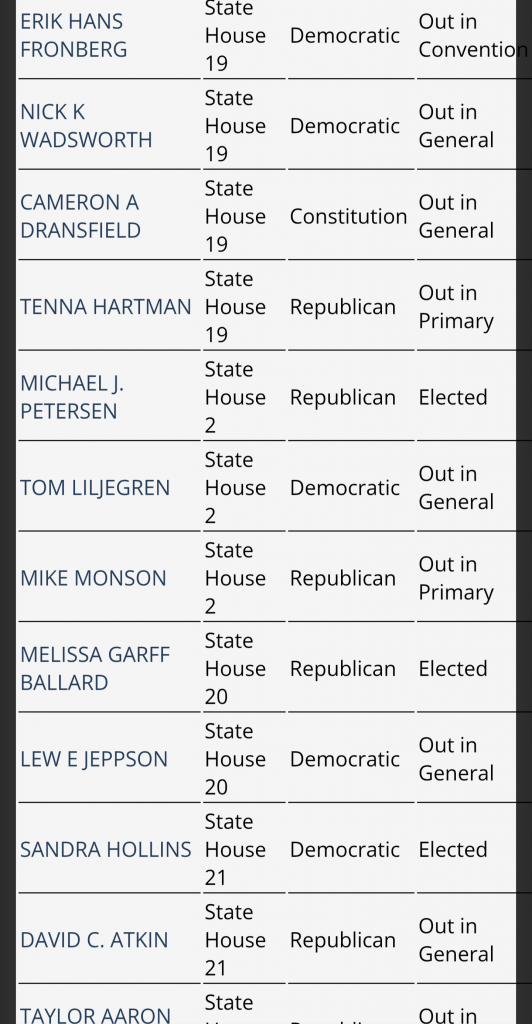
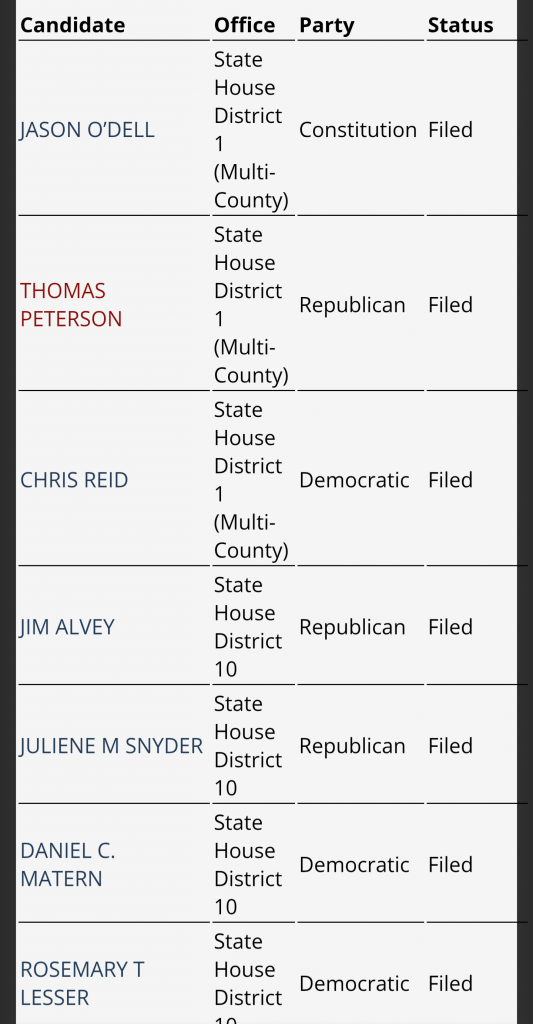
You can see in the 2024 candidate filings that there are dozens of candidates whose filing includes a middle name. In this year’s filings, while some candidates have a middle initial, the only candidates who have a middle name are those who use it in place of their first name or have a nickname.
It’s barely been 24 hours since filing for office and the process has already given rise to a new needed legislative proposal to correct a major error installed by a bill during the 2025 legislative session, which I am going to call SB54 2.0 (you’ll see why).
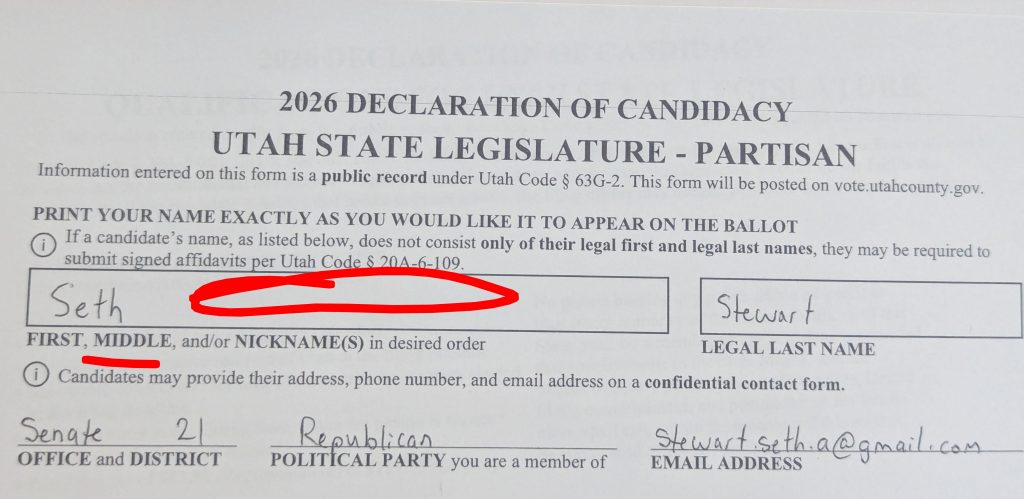
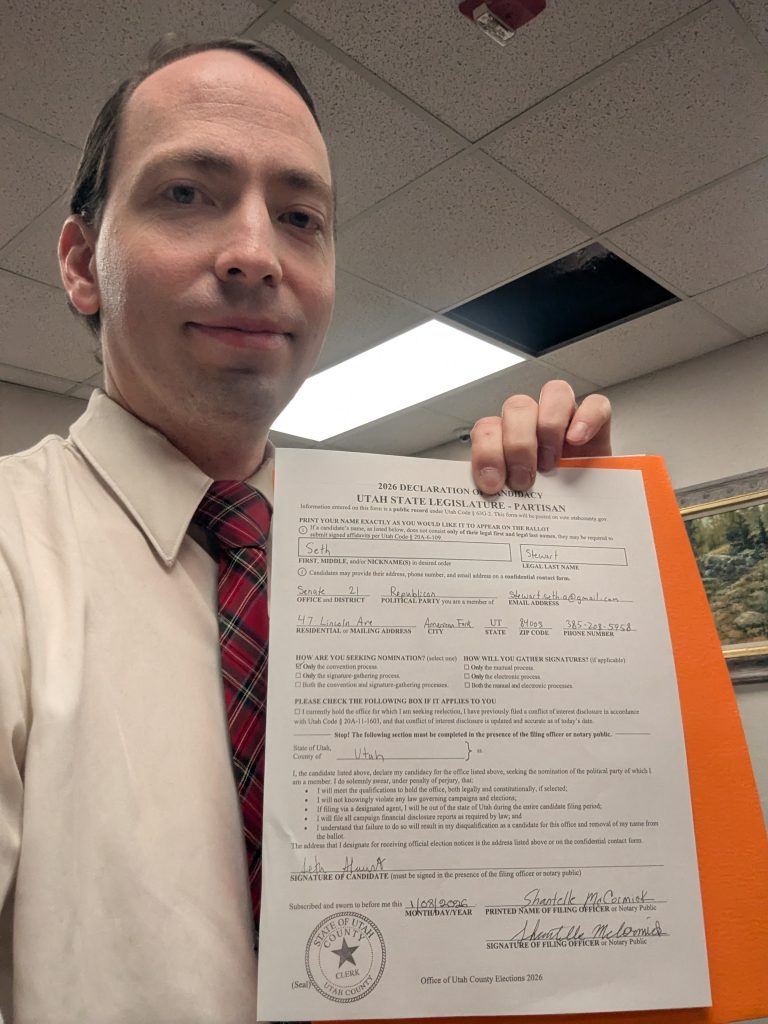
On Thursday, I filed to run for the Utah State legislature, and I tried to include my legal middle name on my Declaration of Candidacy. I had originally filled it out with my middle name and I was told that I had to redo it since it is copied verbatim onto government election records (I had included an extra comma by mistake).
Later, when I tried to include my legal middle name as I was refilling the form with an clerk’s officer, I was told that I would have to fill out an additional form and go through an additional process to have my request satisfied.
Perhaps the worker was mistaken or misunderstood my request, but I understood this to refer to the Name Affidavit form, which requires the signatures of five people who know you to vouch for the name you are known by. I did not have time to gather a sufficient number of family and friends just to have the government recognize me by my full legal name (which it already knows). The form is redundant in my case, and there is no wording in the candidate manual that states or implies that any such additional effort is required to be recognized by your legal middle name or to have it included on the ballot. The claim that I would need to fill out this extra form is simply nonsensical. (You can download the full manual here).
Intentional or not, correctly understood or not, this omission traces back to a very poorly worded law passed last year that does not appear even to handle the default, sensible case.
Candidates like myself intending to do the logical thing by including their legal full names are treated as exceptional cases who require additional documentation and processing. When this is thrown at them last-minute such as when they are filing on the last day, and they have even been informed in advance that there is “nothing more they need to bring with them or do” to file (I called the county clerk’s office in advance to verify this), time does not remain to go and gather the requisite signatures from acquaintances in order to be handled as an “exceptional” case to include one’s middle name on the Declaration of Candidacy.
Especially for candidates who are not government insiders or media celebrities, inclusion of the full name is crucial. In the Internet age, candidates will be unfairly disadvantaged when they are represented contrary to their wishes only by their first and last name on an official government ballot, because many if not most voters will resort to Internet keyword searches to find information about candidates. Without enough disambiguation of the full name, large portions of the search traffic that was meant to find them will instead be absorbed by public figures and media reports about different individuals having the same name, making campaigning more costly for challengers. Such memory-hole behavior can come from anywhere, and it can constitute very real out-of-state media influence in our elections, whether we are honest about this reality or not. I find it very difficult to believe that this statute was not constructed with this awareness.
This is not a complaint about the general nature of Internet searches for individuals by name nor is it a lament that I did not do more things to become infamous on the Internet during my adolescent years, but it is a specific complaint against the Utah statute which has been construed to deauthorize inclusion of a candidate’s middle name in the government filing materials and the government ballot, when the government already knows that legal middle name and it should be as easy as writing it out in full on the Declaration of Candidacy.
My website for candidacy in this race is my full legal name with a .com at the end. (SethAndrewStewart.com). Not being allowed to include my middle name constitutes a very material unfairness and systemic prejudice against candidates like myself who do not already enjoy extensive media coverage and name recognition.
This is also not to say that candidates who do not have a middle name are being treated unfairly by government, it is the unwillingness to recognize disambiguating information that the government already has in its possession such as the candidate’s full legal name, whatever that might be, that is problematic.
It is also simply not the case that candidates never included their middle names in their candidacy filings. In 2024 there were numerous candidates who went by their full legal names including their middle names, and apparently did not have to file anything extra to do so: https://vote.utah.gov/2024-candidate-filings/
This year’s bizarre treatment of middle names appears to be a completely new thing that traces back to the 2025 filing name requirements bill (numbered “SB54”).
I have read the law in question and it appears to be extremely misleading, extremely authoritarian, or woefully undercomplete at best in its omission of the most sensible default case, which makes it understandable how an election worker could easily misapply it to a candidate who is only requesting that his full legal name be included on his declaration for candidacy and on the general election ballot, when all of the prescribed “exception” cases for handling middle names require an additional form or additional triggering condition.
Here is the “base case” of this law, laid out:
20A-6-109. Appearance of candidate's name on ballot -- Name variations -- Appeal.
(1) Except as otherwise provided in this section, an election officer shall ensure that a candidate's name appears on the ballot with the candidate's legal first name, followed by the candidate's legal surname.
What follows deals only in exceptional cases with affirmative authorization language such as “may”, as in you “may include a middle initial under such and such circumstances” and curiously fails to treat the most basic, obvious case of a person simply wanting to be known by his or her full name.
Such narrow construction nonetheless does not appear to authorize an elections officer to refrain from putting the candidates legal middle name on the Declaration of candidacy, but that is apparently how it was interpreted and applied in my case. This is a massive source of confusion.
It does not require a huge change to the law to get this glaring omission addressed, either. I propose that the wording be altered expressly to permit the inclusion of the candidate’s full legal name including any or all middle names or any valid subset of it in the proper ordering, without having to require an exception or additional form. Any name that can be demonstrated to be or is already known on government records to be commonly associated with an individual ought to be permissible on a Declaration of Candidacy without further question or processing. Even if it was just an election officer misinterpreting the law or misunderstanding a candidate’s request, the law should certainly be updated to avoid giving false instructions or misleading county employees.This statute creates a de facto default memory hole that causes a serious disadvantage for candidates who do not already enjoy widespread name recognition and media coverage.It demonstrates that the actual effect of the 2025 legislation is opposite the sense of what it was publicly advertised to do–to “to ensure only accurate legal names go on the ballot, or nicknames under certain circumstances.”
For as well-meaning as it may have been, omission of the obvious default case makes it extremely easy to misconstrue, and has already been weaponized to deny fair ballot access to challengers, even if inadvertently.If this was only a mistake on the part of the elections officer, I will demand a speedy remedy because this is a material omission. If it is construed that this is what the law “means”, or in any case, the law should be amended to eliminate confusion on the subject.
It is also not the case that the government necessarily has to collect filings for candidacy in the first place nor print ballots or place names on them. (Indeed, this is part of my earlier legislative proposal, to eliminate filing fees for candidacy. I thought about filling out a writ of impecuniosity but I think all that would establish is that I don’t meet the government’s poverty threshold, no matter how little money I can actually spare relative to basic living expenses in Utah).
In the early years of the American Republic, candidates did not file with the government, they simply announced their candidacy to the public and voters would write the name of their desired candidate on a slip of paper or use another method to indicate their support. How did they survive?
Maybe decomplicating our elections is the right way to go.
Maybe this sounds like a silly complaint from the perspective of the general public, but I have found there is no better way to find out what is broken in our system than to go and claim and exercise our rights, petition for redress and see which trapdoors open to swallow you and which logs get thrown on your train tracks. You’ve got to experience it for yourself, it’s an adventure of a lifetime.
Go ahead and try this out: Type in your own name in a search engine as though you were researching yourself as a candidate to get an idea of what others will see when they go to do the same.
And now, since you made it to the end of this article, here’s some free bacon:
I have hit the ground running with legislative proposals that resolve Utah’s longest-standing contentions about election integrity, separation of powers and checks and balances. If you’re fed up with increasing housing and living costs, concerned about evaporating water rights, collective bargaining and the right to sue civilly, criminal justice, redistricting shenanigans, judicial overreach, urban sprawl and the bottomless propensity of legislatures to sit on their hands and pretend there is nothing they can do to solve a problem, or offer a pretend solution that makes things worse, this is the right place for you to go.
I can’t fit all of the issues that I am passionate about and strive to find solutions for into one list, so please try me on literally any civic issue relevant to our our state, and I will do my best to give you an informed and constitutionally grounded response.
I’ll be publishing a steady stream of legislative proposals, recommendations and op-eds that actually address and resolve underlying problems that Utahans face, so bookmark this page and subscribe for updates!
If you have questions about the current legislative session, past legislation, legislative proposals, or would like to make or contribute to one, please drop me a line at stewart.seth.a@gmail.com.
My first legislative proposal has to do with the créme de da créme of ending political contention and restoring checks and balances and fair representation to our elections. It directly addresses the concerns raised by Count My Vote and reconciles them with the aims of the Keep My Voice movement, delivering a satisfactory and politically stable outcome and fair representation for everyone. I invite you to read it, understand its principlesh:
Then, I invite you to share it with others, using your own understanding of how this will restore civility and fair representation.
The secret sauce in all of this is to follow the Constitution. Nearly every proposal has to do with reviving a long-lost and completely forgotten constitutional safeguard that has been dismantled over the past 220+ years. The Constitution was meant to be improved and its checks and balances strengthened over time, not weakened or diminished.
Thank you, it’s a pleasure to be part of a republic with you!
Please don’t forget to turn out in force for the caucus and nominating conventions this year! I am running as a convention-only candidate. One of the things I love most about caucus as an election method is that you can actually get to know the people you are voting for rather than relying only on mailers, advertisements, news media and name recognition, which tend to favor candidates with a lot of money and existing political connections. I invite you to meet with me at upcoming events.
If you would like to donate time or means to the campaign, please reach out to me through my email.
This is an open letter to the mayor and city council of American Fork, Utah, intended for review and distribution to all residents of the city. Copies of this letter were also sent by email to the mayor and city council members.
Dear Mayor and city council members of American Fork,
The “HW Romance Boutique” at 63 E Main Street poses a public nuisance that is inconsistent with the moral standards of the residents of our community due to its sexually themed merchandise and storefront that purveys such content to the public. The Articles of Incorporation of our city state that the city council shall have power: “To tax, restrain, prohibit and suppress tippling houses, dram shops, gaming houses, bawdy and other disorderly houses.” (Sec. 22, Articles of Incorporation)
This sexually oriented retailer assails the senses of commuters on Main street, pedestrians and runners, churchgoers, residents, tourists, visitors, library patrons, schoolchildren, merchants and bystanders alike. As an establishment offensive to public decency, tending to corrupt and deprave, and contrary to the public interest of promoting wholesome family values, it has no place in our town.
I call on the city council to shutter the indecent business at the above location and all other indecent businesses and storefronts wherever situated within the municipality’s boundaries immediately.
Respectfully, -Seth Stewart
Relevant section of the Articles of Incorporation of American Fork:
Over the past several weeks I have attended the city council meetings having to do with the budget for June 2025-2026, and I had a burning question: What is our city actually authorized to spend our money on?
I searched our city’s website and found no detailed documentation about what the city’s charter is. There are some older meeting minutes as well as a news article or two online that make mention of an alleged charter back in the day. A charter functions like a Constitution, but for a city: It is an exhaustive list of all the powers that we the people grant the municipal government to exercise on our behalf, in addition to providing structure and express limitations and checks on its power.
I called our city recorder and she was able to get documents to me very responsively about American Fork’s articles of incorporation (1853). Articles of incorporation aren’t the same thing as a citizen-ratified charter, but they do contain some goodies that we talk too little about. For example, it purports to grant to the city power to levy taxes to build and maintain roads and aqueducts, and even to regulate powder magazines and build parapets and defensive walls. Good times! In short, the articles of incorporation provide us with useful talking points because they contain an enumeration of powers–whether those powers are ratified by the citizenry is a different matter, but at a minimum, it can safely be assumed that no unenumerated power actually belongs to the city.
On that note, there are several big things these articles of incorporation do not include. As I look through their grant of powers in comparison to our spending items, there are evident areas of non-overlap. I raised to the city council my questions about numerous special spending projects under the headings such as “economic development” and “(re)-investment”. The articles of incorporation make reference to maintaining public marketplaces, but there are worlds of difference between public marketplaces and economic development funds in general, or “investing”. In fact one of the reasons why “investment” as a priority and the city’s signaling of “economic development project areas” raise a red flag with me is that this is the very sort of thing that Governor Cox’s BUILD Council executive order (a reincarnation of the legislature’s “Beehive Development Agency” from its failed SB337 “Land Use and Development Amendments” bill) and federal analogues attempt to accomplish: Practically unlimited power of the purse to claim eminent domain for their own purposes (think of an HOA with the size and funding of the Death Star) and pick and choose winners and losers in private markets.
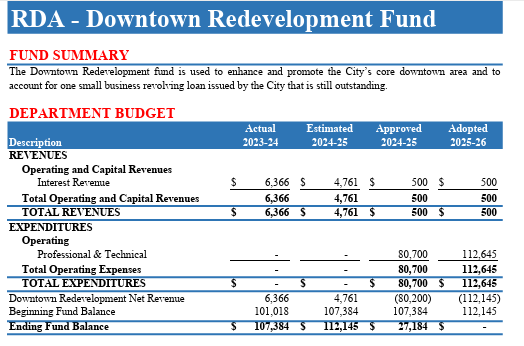
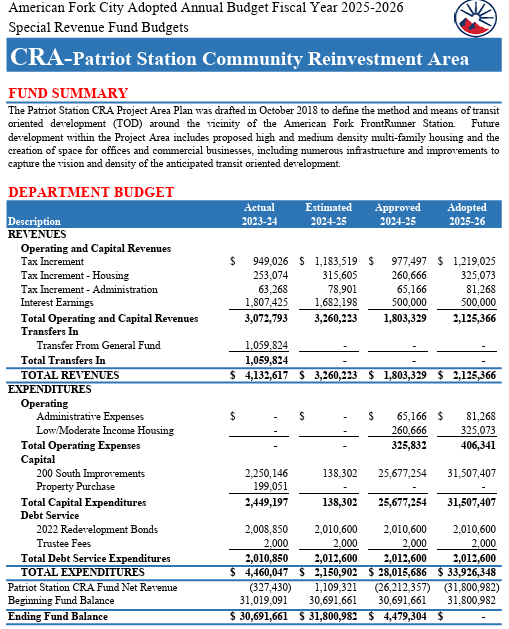
I asked about the outstanding small business loan our city has allegedly issued and have yet to receive an answer. Nothing in our city’s articles of incorporation appears to authorize the city to issue loans. Then there is the high and medium high density housing development project by the frontrunner station and other projects like the Egg Farm Development Area’s “affordable housing” mandatory spending. (You can find the special project funds on pages 132-142 of the city’s published budget packet here.)
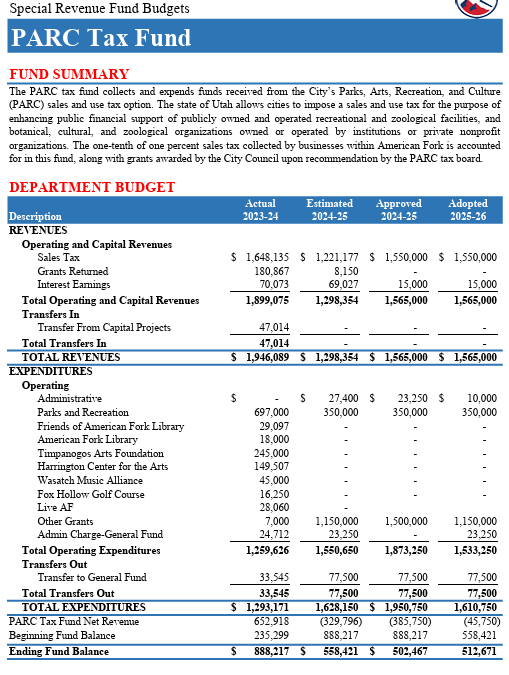
The PARC tax has earmarked $1,565,000 for the 2025-26 budget. If there are 40,000 residents in American Fork, that’s about $40 per person per year. The amount paid per taxpayer would be considerably higher (likely $100 or more). Don’t get me wrong, I enjoy our parks, but most of this fund isn’t going towards parks. I don’t see opera halls, dance houses or entertainment troupes in the powers ostensibly granted to the city in its articles of incorporation. Do you?
I have been asked about broadband, fiber and the recreation center. The answer I give is simple: If we did not give our municipal government authority to do those things in its charter, then it has no authority to do them. It’s as simple as that. The Founding Fathers understood this as the principle of popular sovereignty.
If we don’t see a specific grant of power to do some things in the city’s enumerated powers, We don’t just start doing them and then assume they are legitimate. If the people think that something needs to be funded by the city as a public facility that was not formerly recognized by them as such via the grant of powers to the government, then the people need either to vote that into a charter or reconsider whether it truly belongs as a governmental operation as opposed to being serviceable through the private sector.
If I am elected, I will urge our city council to adopt formally a charter form of government, which the state recognizes in some form under Article XI, Section 5, although the power of the people is actually greater than that recognized under this article–actually returning power to the people to say what the government can do (and correspondingly, forbidding it to do anything they do not authorize it to do). Let me know your thoughts, frustrations, questions, comments and insights. Thanks as always for defending your neighbor’s rights.
I invite the city council members, mayor and candidates for city office to respond to these questions about any documented grant of powers relative to these budget categories, and the source of the city’s power.
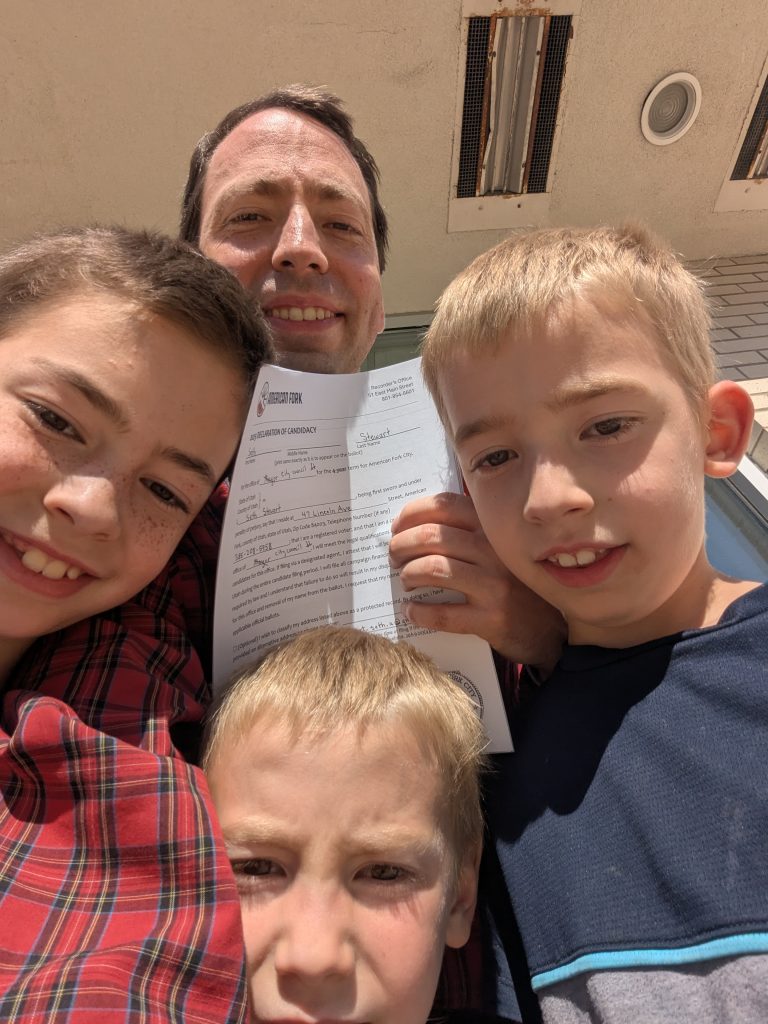
On Friday I filed to run for city council in my town of American Fork. I have spent hundreds of hours visiting with people who have lived here for longer than we have, and our connections here have roots that go back the better part of a century (or even further once we get into our family history). We listen to and try to serve people of all backgrounds and ages, from 98 year olds to our newborns. My wife and I now have a family of eight, and if there is one thing that makes life for families and individuals more complicated, it is the steady encroachment of anti-family influences including policies that curiously work against us in our neighborhoods, employment and homes despite our best efforts to represent ourselves.
I believe it is our right and our responsibility to petition governments for redress of grievances including the little things that add up to significant impediments, and to be proactive in offering to serve and contribute solutions where we can. Many people I have talked with either believe that participation in politics is hopeless because of corruption, or that they lack the time, means or skills to contribute. We need to address both halves of this problem.
I understand not running for an office because of life’s other more pressing concerns–that is where I come from personally–but there has also been historically low participation especially in our local and municipal elections in recent years. There is also a feeling of futility. I have tried to make a difference in national politics, with little or no measurable success. I have raised my voice to improve our state policies, only to be ignored. I have some reasons to believe I have improved our county politics, but where I have found we can make the most difference is right in our own homes and towns.
In the Internet age, too often we only pay attention to national voices and offices, and increasingly our lives, our fortunes and even our peace becomes tied to some remote thing that we have no control over. This effect centralizes power, removes checks and balances, and surrenders autonomy, draining life of its happiness. The unity and shared identity we ought to enjoy at the community level is often fractured by the latest thing on social or news media. We urgently need more grounding in what can be most enduring: our faith, our families, and our community.
The contention in political discourse often leads to either talking past each other with anger or shutting down all conversation on political topics (as though avoidance were a solution). Having a disagreement is not contention. Trying to solve hard problems is not contention. There are right and wrong answers and there are ways to improve our situation by the application of intelligence. Each of us is capable of doing this in some degree, and we need each other’s input. The authors of the Federalist Papers urged the necessity of union. Even ignoring the dangers of invasion, the fracture of society internally leads to nihilism, depression and despair. We are meant for better things.
What if we reframe the conversation? Instead of thinking in terms of “politics”, which usually devolves into mudslinging which are so well-worn that they are now battle trenches, what if we think in terms of policies? We can each name policies that make our lives better or worse than alternatives. We can each share ways to make policies better for ourselves, and if we talk to others and incorporate their feedback, we can make things better for them at the same time. If we are principled and discerning we can make things better for everyone.
Laws and municipal codes express policies. Therefore we have a need to speak up about and inform the making of our laws and municipal codes. Anyone who is suffering from systemic unfairness or unwisdom deserves to have his or her interests protected by those who wield any amount of power in making, enforcing and interpreting policies.
Yesterday at an event at the capitol I felt I should ask a stranger in the crowd what he thought about an election transparency question I was having difficulty finding a solution to. I believe his thoughtful answer solved my problem. This is not an isolated event! I invite you to express your frustrations as well as contribute your thoughts and recommendations to make our shared policy for living in our city better for everyone.
Now there is a temptation to try to categorize people by their alliances in national politics. This is usually if not always a terrible idea. Abetted by media smokescreens and spending, national matters are usually so far removed from our powers of direct observation and influence that such an approach limits discernment. I am not one who believes in either virtue or guilt by association. I believe every person will answer for his own choices, whether good, bad or mediocre. This helps us have conversations without shutting down good ideas merely because the person they are coming from voted for someone we wouldn’t have voted for–that is simply toxic perfectionism. While we ought to avoid perfectionism, I believe we can make our government better, and someday perhaps we may even enjoy a perfect government.
I believe we can succeed at opposing government overreach at all levels by asserting our rights and autonomy locally, following the pattern expressed by our founding fathers in the ninth and tenth amendments. I believe checks and balances are the missing key ingredient to restoring life, liberty and happiness to all who are willing to pay that price.
Importantly, I wish to express that this run for office should not be construed as a blanket vote of no confidence in our current mayor or city council. Generally the more vigorous competition there is for an office, the more vetting the voters do, the better candidates end up being elected and the better informed the political officers end up being on how to serve the people.
If you have concerns you would like to raise or ideas you would like to share, please, let’s meet! Let’s discuss and find policies that will make life better for everyone, not just many or few. Then let’s act on it to raise the issue and move our policies and practices in the right direction using the means available to us. This is what I love to do and will continue to do all my life whether I am in a race for office or not.
Please send me an email if you’d like to talk or meet, send me a message or give me a call at 385-208-5958.
I’ve been a participant in the delegate system in Utah since I became a full-time Utah resident in 2016. Here are the issues I have been working on to restore constitutional government:
1. Repeal and replace SB54. Several Republican colleagues in the party and its leadership have informed me that I am the only person they know of who has proposed an actual solution to the problem of Utah’s signature gathering law SB54. Count My Vote has threatened a ballot initiative to abolish the caucus system altogether, and for this reason many of our SCC members and legislators are hesitant to push for a repeal of SB54. We actually have leverage on this issue against them! It turns out the United States Constitution fully answers their concerns with the caucus system. We can use this as a powerful bargaining chip. The only rebuttal they can come up with is that they don’t actually want a fair, representative election system complete with constitutional checks and balances. We can and should use this information against the enemies of the caucus system. Please help the cause of freedom by raising awareness of the constitutional solution to SB54! Video with details on how to eliminate SB54:
2. Eliminate blueshift in our election system. The people of the State of Utah and particularly Republicans have been misrepresented in our elections, by the party and the state conspiring to put democrat-leaning candidates in the place of our convention nominees. Of course this bait-and-switch fuels the critics of the caucus system, by pretending that delegates are “out of touch” with the public when in fact the US Constitution points out that republican election methods provide a check against democratic ones by design. Like them or not, the 2024 Republican convention nominees have a great point: There should not be a pay-to-play system, and the people should actually have control over their nominees. I warned delegates about the blueshifting of candidates before we saw it happen in 2024!
I also performed an in-depth analysis of Tracie Halvorsen’s petition to the United States Supreme Court against SB54. With no apology to the critics of such appeals, the petition is excellent and it actually reveals the core problem with partisan multi-track balloting systems nationwide. In a nutshell, the problem is that by giving some parties special access to put their nominees on the ballot, the parties actually become part of the government and are controlled by it. Yes, we are literally living in George Orwell’s Animal Farm, where “some animals are more equal than others”. If we recognize this problem and put pressure on the legislature to establish a uniform ballot access mechanism instead of the multi-track system of today, we could forever prevent the problem of our convention nominees getting pushed off the ballot by state-sponsored RINOs. See the video for a complete unpacking of the petition:
3. I have proposed a working and fair solution to the problem of the convention taking 17 hours, that also solves the problem of RINOs having an unfair advantage in our convention. What was up with the 2024 State Convention taking so long? Why do RINOs like Curtis keep winning? It turns out these two questions are related. There is no good reason to take so long, or to keep handing nominations or paths to a primary to RINOs. I created a website, ConstitutionalVote.org, that highlights the solution to both of these problems. It turns out that yet again, the Constitution has the solution to our problems! The crux is that the Constitution allowed electors to vote for more than one candidate, which is a form of what is known as Approval Voting. Approval voting is simply treating a ballot as checkboxes instead of radio buttons.
An approval voting ballot looks like this:
☐ Rotten Joe Tolerable Suzy Okay Sam
While the current system (Plurality Voting or First-Past-The-Post) looks like this:
○ Rotten Joe ○ Tolerable Suzy ◉ Okay Sam
This is why RINOs keep winning: They split the vote between good candidates. The more good candidates there are in a race, the more likely it is that the least tolerable candidate will win. It is not solved by multi-round voting systems, which are a form of ranked choice voting where you can reallocate votes between rounds. It is still prone to the problems inherent in ranked systems.
I have also offered to debate publicly with anyone who disagrees with these mathematical realities and their ramifications. If you want more detail you can see Veritasium’s video (a math and science nerd like me with 17.5 million followers) below, detailing why ranked methods are inherently mathematically unstable and misrepresentative, while rated systems solve the problem (the Constitution requires a hybrid of a rated and ranked system, allowing us to get the best of both kinds of systems, while never requiring multiple rounds!). By eliminating the multi-round aspect, our caucus and convention races can be completed in half the time, saving the party millions of dollars in volunteer time and allowing us to get to the important business. Oh, and the Constitutional method also provides an easy way to fill multi-seat races. Oh, and we can also return easily to paper ballots since it is the easiest possible method to count and audit. Computers are never required! If anyone has a serious critique to the Constitutional method, I have yet to hear it.
4. I inform the public about the bills being pushed in our state and I push back on our legislature against bad bills. I am an AI professional and I am working on a tool to use AI to analyze bills for constitutional problems (stay tuned for updates!). I have gone to capitol hill to testify during the legislative session against bills that contain very serious poison pills and consolidation of power, including notably:
SB203 (Sponsor: Brady Brammer; seriously weakens standing in civil suits)
SJR6 (Sponsor: Wayne Harper; seizes unlimited power for the state under a false definition of federalism that ignores enumerated powers and the supremacy of the people over the states per the 10th Amendment)
and many more (stay tuned for updates to this list)!
5. I have submitted my own petition to the United States Supreme Court to end judicial overreach and restore jury trials. This is a bipartisan issue. Thomas Jefferson warned us that trial by jury is “the only anchor, ever yet imagined by man, by which a government can be held to the principles of its constitution”. This is true! If we cannot resist the enforcement of bad laws or mandates, regardless of the dollar amount at stake, we have forfeited freedom and entered into the era of the police state in the name of the public good. Governments need to be monitored and checked at every point and there is no more capable institution to do this than to restore the citizen watchdogs through grand juries and jury trials.
In short, I emphasize the most important issues–Actually restoring constitutional checks and balances (instead of just trusting party leaders not to sell us out to the government) and teaching and warning against the misrepresentations of parties and their unholy alliances with governments.


 Tolerable Suzy