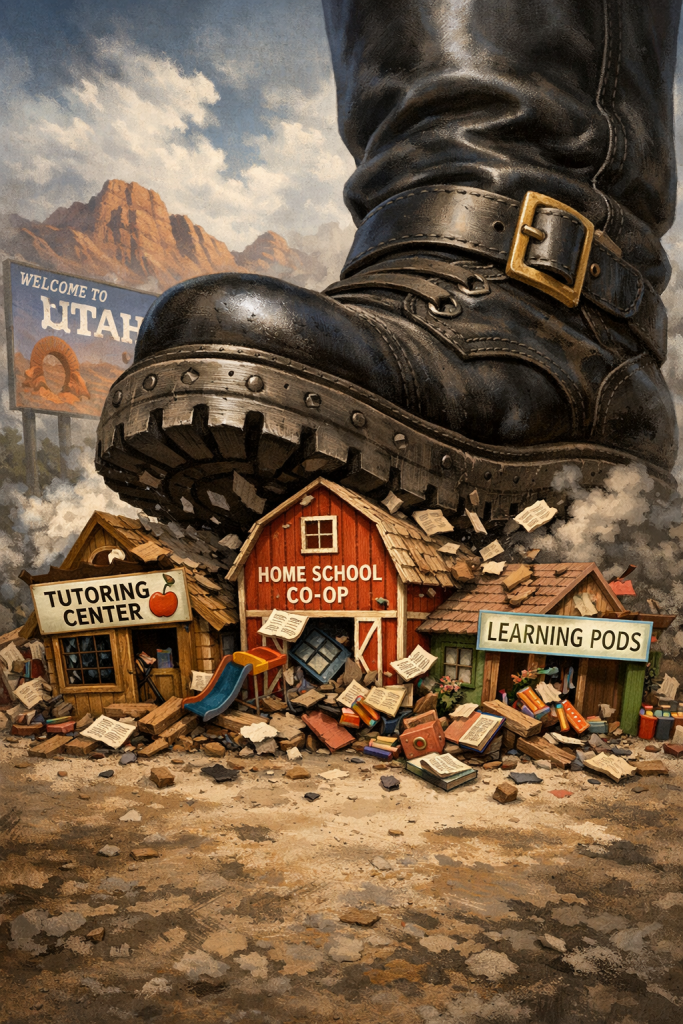
Utah H.B. 126 “Micro-Education Entity Facility Amendments” does significantly more than merely modernize facility and safety requirements for small educators. It eliminates natural growth options for such educational businesses.
The bill negatively affects school choice. Cost to enroll a child in a nature-based homeschool or homestead school, or any other small educational business could increase by a thousand dollars or more annually with this new requirement. It hampers truly private educational institutions that compete with state-sponsored education by requiring them to lease or purchase expensive commercial property even if they don’t need it.
The key change in the bill is that transition from small home-based education to larger “micro-education entities” is no longer gradual. Once a group is reclassified as a micro-education entity, commercial building, fire, and other requirements apply immediately, and residential use is no longer allowed.
The bill forbids retrofitting residences for micro-educational use, which means that the cost to run and grow an education business organically would increase significantly, potentially shuttering and preventing the formation of many legitimate and home-grown education businesses.Groups trying to scale, professionalize, or expand their educational offerings face a much steeper jump in cost and compliance, often requiring commercial space sooner than expected. The cost of such compliance would require very significant jumps in tuition and fees for students.
By hampering the economic viability of small businesses, the bill unfairly favors corporations with government or other deep-pocketed backing–just like many other bills in this session that squash private enterprise under myriad excuses. Unregulated education groups are also more likely to come under scrutiny or be reclassified in the future as competing with state-sponsored educational initiatives and therefore become subject to an ever increasing regulatory creep.
HB 126 doesn’t ban homeschool or co-ops—but it makes scaling small education efforts costlier and more sensitive to regulation and future legal status changes. It fundamentally changes how education groups are treated once they grow or formalize into a business entity, effectively limiting their growth and interfering with the free market conditions guaranteed under Article 12 Section 20 of Utah’s Constitution.
As to its primary effect, it really isn’t about safety — it is about crushing the growth of independent competition in the educational space by imposing industry-targeted facility requirements in the name of safety. Please join the committee hearing on Monday, January 26th at 2:00 p.m. to help salvage our right to educational independence:
https://le.utah.gov/committee/committee.jsp?year=2026&com=HSTPOL
https://le.utah.gov/~2026/bills/static/HB0126.html
Leave a Reply