It’s barely been 24 hours since filing for office and the process has already given rise to a new needed legislative proposal to correct a major error installed by a bill during the 2025 legislative session, which I am going to call SB54 2.0 (you’ll see why).
On Thursday, I filed to run for the Utah State legislature, and I tried to include my legal middle name on my Declaration of Candidacy. I had originally filled it out with my middle name and I was told that I had to redo it since it is copied verbatim onto government election records (I had included an extra comma by mistake).
Later, when I tried to include my legal middle name as I was refilling the form with an clerk’s officer, I was told that I would have to fill out an additional form and go through an additional process to have my request satisfied.
Perhaps the worker was mistaken or misunderstood my request, but I understood this to refer to the Name Affidavit form, which requires the signatures of five people who know you to vouch for the name you are known by. I did not have time to gather a sufficient number of family and friends just to have the government recognize me by my full legal name (which it already knows). The form is redundant in my case, and there is no wording in the candidate manual that states or implies that any such additional effort is required to be recognized by your legal middle name or to have it included on the ballot. The claim that I would need to fill out this extra form is simply nonsensical. (You can download the full manual here).
Intentional or not, correctly understood or not, this omission traces back to a very poorly worded law passed last year that does not appear even to handle the default, sensible case.
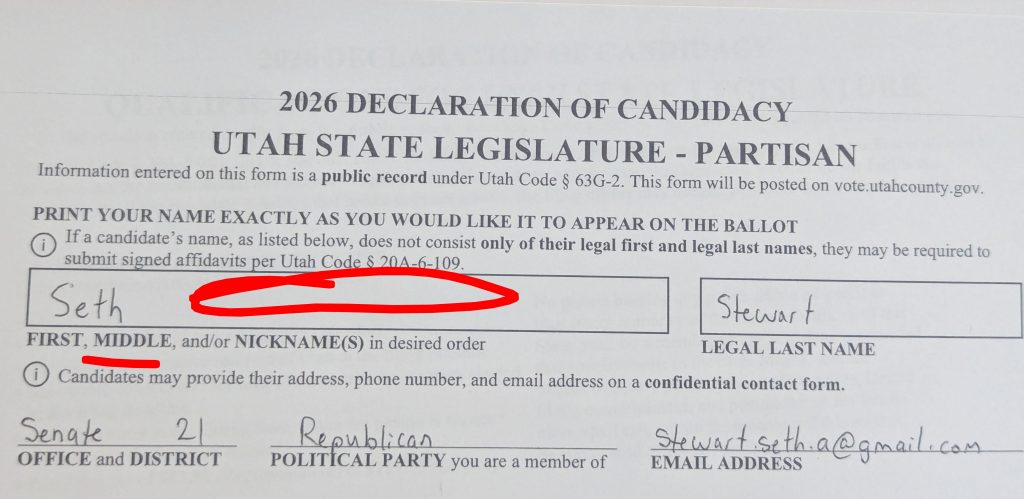
Candidates like myself intending to do the logical thing by including their legal full names are treated as exceptional cases who require additional documentation and processing. When this is thrown at them last-minute such as when they are filing on the last day, and they have even been informed in advance that there is “nothing more they need to bring with them or do” to file (I called the county clerk’s office in advance to verify this), time does not remain to go and gather the requisite signatures from acquaintances in order to be handled as an “exceptional” case to include one’s middle name on the Declaration of Candidacy.
Especially for candidates who are not government insiders or media celebrities, inclusion of the full name is crucial. In the Internet age, candidates will be unfairly disadvantaged when they are represented contrary to their wishes only by their first and last name on an official government ballot, because many if not most voters will resort to Internet keyword searches to find information about candidates. Without enough disambiguation of the full name, large portions of the search traffic that was meant to find them will instead be absorbed by public figures and media reports about different individuals having the same name, making campaigning more costly for challengers. Such memory-hole behavior can come from anywhere, and it can constitute very real out-of-state media influence in our elections, whether we are honest about this reality or not. I find it very difficult to believe that this statute was not constructed with this awareness.
This is not a complaint about the general nature of Internet searches for individuals by name nor is it a lament that I did not do more things to become infamous on the Internet during my adolescent years, but it is a specific complaint against the Utah statute which has been construed to deauthorize inclusion of a candidate’s middle name in the government filing materials and the government ballot, when the government already knows that legal middle name and it should be as easy as writing it out in full on the Declaration of Candidacy.
My website for candidacy in this race is my full legal name with a .com at the end. (SethAndrewStewart.com). Not being allowed to include my middle name constitutes a very material unfairness and systemic prejudice against candidates like myself who do not already enjoy extensive media coverage and name recognition.
This is also not to say that candidates who do not have a middle name are being treated unfairly by government, it is the unwillingness to recognize disambiguating information that the government already has in its possession such as the candidate’s full legal name, whatever that might be, that is problematic.
It is also simply not the case that candidates never included their middle names in their candidacy filings. In 2024 there were numerous candidates who went by their full legal names including their middle names, and apparently did not have to file anything extra to do so: https://vote.utah.gov/2024-candidate-filings/
This year’s bizarre treatment of middle names appears to be a completely new thing that traces back to the 2025 filing name requirements bill (numbered “SB54”).
I have read the law in question and it appears to be extremely misleading, extremely authoritarian, or woefully undercomplete at best in its omission of the most sensible default case, which makes it understandable how an election worker could easily misapply it to a candidate who is only requesting that his full legal name be included on his declaration for candidacy and on the general election ballot, when all of the prescribed “exception” cases for handling middle names require an additional form or additional triggering condition.
Here is the “base case” of this law, laid out:
20A-6-109. Appearance of candidate's name on ballot -- Name variations -- Appeal.
(1) Except as otherwise provided in this section, an election officer shall ensure that a candidate's name appears on the ballot with the candidate's legal first name, followed by the candidate's legal surname.
What follows deals only in exceptional cases with affirmative authorization language such as “may”, as in you “may include a middle initial under such and such circumstances” and curiously fails to treat the most basic, obvious case of a person simply wanting to be known by his or her full name.
Such narrow construction nonetheless does not appear to authorize an elections officer to refrain from putting the candidates legal middle name on the Declaration of candidacy, but that is apparently how it was interpreted and applied in my case. This is a massive source of confusion.
You can read the full text of the current law here: https://le.utah.gov/xcode/Title20A/Chapter6/20A-6-S109.html
It does not require a huge change to the law to get this glaring omission addressed, either. I propose that the wording be altered expressly to permit the inclusion of the candidate’s full legal name including any or all middle names or any valid subset of it in the proper ordering, without having to require an exception or additional form. Any name that can be demonstrated to be or is already known on government records to be commonly associated with an individual ought to be permissible on a Declaration of Candidacy without further question or processing. Even if it was just an election officer misinterpreting the law or misunderstanding a candidate’s request, the law should certainly be updated to avoid giving false instructions or misleading county employees.This statute creates a de facto default memory hole that causes a serious disadvantage for candidates who do not already enjoy widespread name recognition and media coverage.It demonstrates that the actual effect of the 2025 legislation is opposite the sense of what it was publicly advertised to do–to “to ensure only accurate legal names go on the ballot, or nicknames under certain circumstances.”
Part of the rationale?
To kick “Satan” off the ballot:
You can’t make this stuff up.
Here is the 2025 SB54 bill text:
https://le.utah.gov/~2025/bills/static/SB0054.html
For as well-meaning as it may have been, omission of the obvious default case makes it extremely easy to misconstrue, and has already been weaponized to deny fair ballot access to challengers, even if inadvertently.If this was only a mistake on the part of the elections officer, I will demand a speedy remedy because this is a material omission. If it is construed that this is what the law “means”, or in any case, the law should be amended to eliminate confusion on the subject.
It is also not the case that the government necessarily has to collect filings for candidacy in the first place nor print ballots or place names on them. (Indeed, this is part of my earlier legislative proposal, to eliminate filing fees for candidacy. I thought about filling out a writ of impecuniosity but I think all that would establish is that I don’t meet the government’s poverty threshold, no matter how little money I can actually spare relative to basic living expenses in Utah).
In the early years of the American Republic, candidates did not file with the government, they simply announced their candidacy to the public and voters would write the name of their desired candidate on a slip of paper or use another method to indicate their support. How did they survive?
Maybe decomplicating our elections is the right way to go.
Maybe this sounds like a silly complaint from the perspective of the general public, but I have found there is no better way to find out what is broken in our system than to go and claim and exercise our rights, petition for redress and see which trapdoors open to swallow you and which logs get thrown on your train tracks. You’ve got to experience it for yourself, it’s an adventure of a lifetime.
Go ahead and try this out: Type in your own name in a search engine as though you were researching yourself as a candidate to get an idea of what others will see when they go to do the same.
And now, since you made it to the end of this article, here’s some free bacon:
≈≈≈ ≈≈≈ ≈≈≈
Leave a Reply