All three branches have acted–or agreed by inaction–to preserve the status quo.
By Seth Stewart
Legal Lockouts, Nonfeasance, and the Officials Who Kept Planned Parenthood’s Injunction Afloat
On June 24, 2022, Utah officials announced that S.B. 174—the State’s abortion ban—had become operating law. The following day, Planned Parenthood sued. Within days, a single district-court judge had “temporarily” blocked its enforcement throughout the State. Fast-forward to today: Nearly four years later, no jury has examined and rejected S.B. 174 as applied in any case. No court has tried the controversy and found the law unconstitutional. No judge has entered a final judgment on its merits. This article exposes the machinery that makes these delays possible, as well as a further foundational threat to the survival of civilization that it hides.
Utah’s official abortion figures suggest that roughly fifteen thousand (15,000) abortions have been performed in Utah while S.B. 174 has been blocked. Delay costs blood.
The worse news is that the delays cannot be attributed solely to a judge somewhere; others were involved. The State Attorney General. The Governor. The Legislature. All three branches acted–or failed to act–in ways that favored the lethal status quo and drew out the timeline, all while laboring to give the public appearance of meaningful opposition to an act of judicial overreach. Through simple but significant negligence, each branch can claim to be “helping” while passing the buck for failures and working against the legitimate, constitutional interests of the people. This isn’t a story of backroom deals caught on tape. Instead, public fruits speak volumes: While token opposition preserves a semblance of plausible deniability, the public deserves to know that abortion could not remain legal in the state of Utah without a complicit legislature and executive.
A crucial question we will answer is, How did a supposedly temporary constitutional remedy become an instrument of forceful, prolonged bloodshed? A road through history paved with good intentions holds the answer. Regardless of intent, the public record reveals a recurring pattern: the injunction has survived every act of defiance. Planned Parenthood’s legal position has even been strengthened by the attacks on it, and the role of citizens has quietly diminished. The greatest power shift isn’t even evident only in the preservation of the status quo, but in an Earth-shattering discovery of what the Utah legislature is really installing, evidenced again and again by actions that didn’t match words, and bills that concealed weapons of mass destruction against the real constitutional protections, while putting on a dog and pony show for our placation.
What follows is a staggering testament to repeated failures across all branches of government, with even more grave failures of checks and balances. With each successive failure, it is revealing to ask:
What justified this failure?
Hang on to your constitutions. By the end of this, we will see that the founding fathers had it right all along. The answer to how to end abortion for good is hidden in plain sight.
Table of Contents: The Sequence of Failures, and How to Succeed
Here is a brief outline we will follow to highlight exactly how actors in government enable abortion to this day:
- The Dobbs Decision: Poison Pills that Kicked Federal Malfeasance to the States
- The Law that Never Was–SB 174’s Backdoor to Judicial Supremacy
- “Preliminary Injunction”–a traditional remedy retrofitted with a Death Star superlaser
- The State Refused to Build an Evidentiary Record on Appeal
- H.J.R. 2 Was Designed to derail Planned Parenthood’s injunction, but was not used
- Meet the Cast: The State Actors
- S.B. 203 locked out citizens by deleting constitutional standing (too late to stop abortions)
- S.B. 204 gave the State a weapon–but citizens cannot force it
- S.J.R. 9 narrows future injunction access–but Planned Parenthood was already inside the gate
- H.B. 392/S.J.R. 5 reveal the the state’s endgame: Exclusive control over constitutional venues
- H.B. 366 preserves the same architecture if challenged: fallback Constitutional Court
- H.B. 79 and H.B. 330 shield officials from accountability: immunity replaces jury redress
- Conclusion: this is not anti-judicial supremacy; it is State-managed judicial supremacy
- The Constitutional Solution: We were trained never to look here.
1. Federal Malfeasance Metastasized to States: Dobbs Treated Abortion as Federalism, Ignoring Protections for the Right to Life
The Dobbs decision by the Supreme Court in 2022 corrected Roe v. Wade only in part. It held that the federal Constitution does not confer a right to abortion and returned the issue “to the people and their elected representatives.” Dobbs fell short of a real constitutional solution by kicking the can to the states–but abortion is not merely a “states’ rights” issue. It is a human rights issue involving the protected right to life, which the federal government is constitutionally obligated to uphold. It is difficult to calls Dobbs a true victory, since in that decision the federal government doubled down on its past precedent of refusing to fulfill its constitutional duty to protect life. Current federal doctrine is that people can still be denied the right to life simply by refusing to recognize the personhood of undesired classes of people.
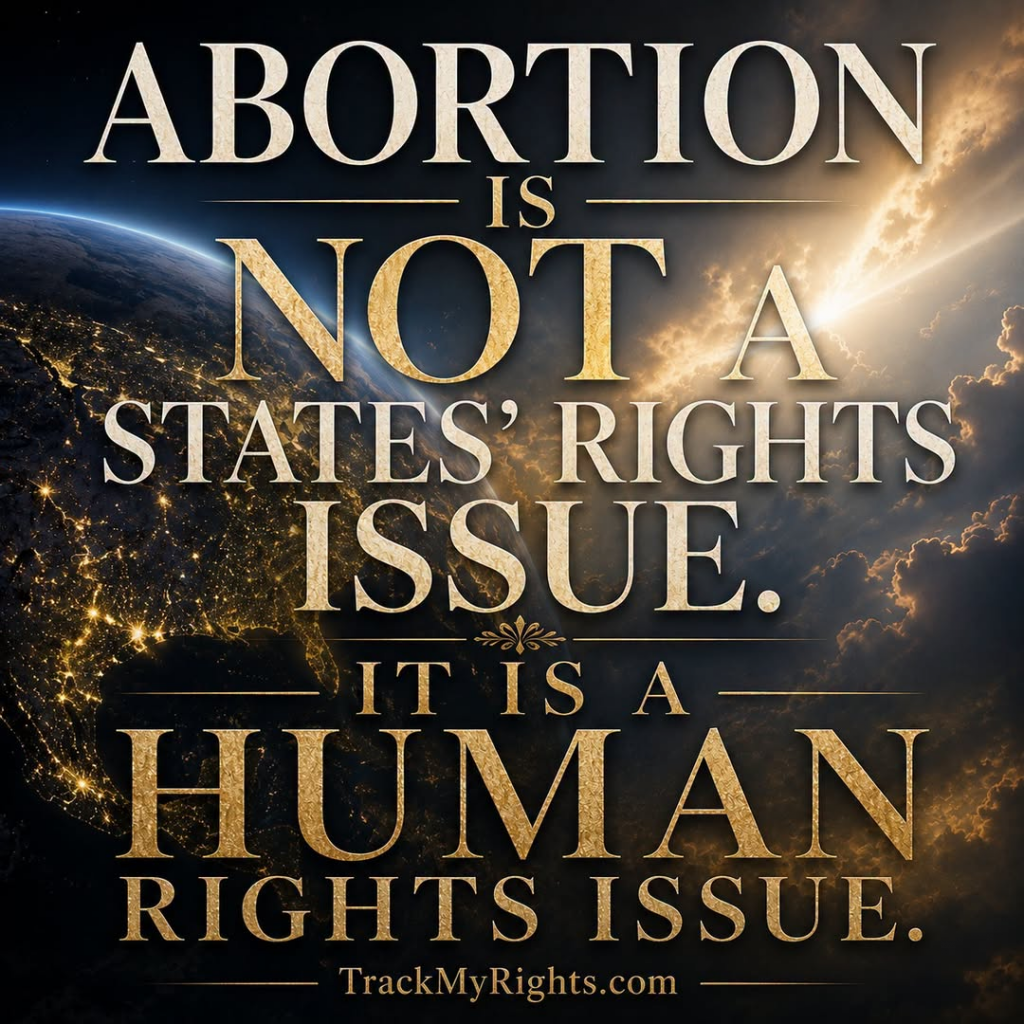
No government, federal or state, has legitimate authority to authorize the deprivation of life without due process of law. Utah’s Constitution begins with the declaration that “all persons” possess the inherent and inalienable right to enjoy and defend their lives and liberties. It bars deprivation of life, liberty, or property without due process; preserves jury trial; commands that courts remain open for redress; and declares its provisions mandatory and prohibitory. A government sworn to that Constitution had a duty to treat S.B. 174 as protective law, not as a political prop waiting for indefinite judicial permission.
Dobbs removed the federal Roe/Casey obstacle, in theory–but the legislature’s own actions as well as the executive’s consistently demonstrate deference to judicial supremacy, rather than meaningful opposition to it.
2. SB 174–The Law that Never Was–Surrender from the Start (Nonfeasance #1)
Utah’s S.B. 174, enacted in 2020 and sponsored by Senator Dan McCay and Representative Karianne Lisonbee prohibited abortion at any stage of pregnancy except in narrow circumstances. It made unauthorized abortion a second-degree felony and created licensing consequences for physicians and clinics. This was hailed as a major victory for pro-life Utah–but it came with a significant caveat: the Legislature drafted it with a contingent effective date. It was to become operative only after legislative general counsel certified that a “binding” court held that a state could prohibit abortion throughout gestation. In other words, the legislature willingly bound itself in advance to follow state and/or federal court precedent–an open surrender to judicial supremacy, and a self-inflicted potential inversion of federalism.
Alexander Hamilton described the judiciary as possessing “neither FORCE nor WILL, but merely judgment”. A legislature that asks judges for permission to legislate, or an executive that treats every judicial opinion as a generally applicable command, transfers force and will to the one department designed to possess neither.
Jury verdicts and final judgment can bind the parties to a case–but the reasons written in a judge’s opinion are not a new statute governing parties who were absent from the case. Here we witness a voluntary exchange of power, amounting to judicial overreach by legislative permission. In SB 174, the Legislature announced a duty and then made performance of that duty wait upon judicial permission. This is one of the clearest acts of nonfeasance at the abortion ban bill’s inception.
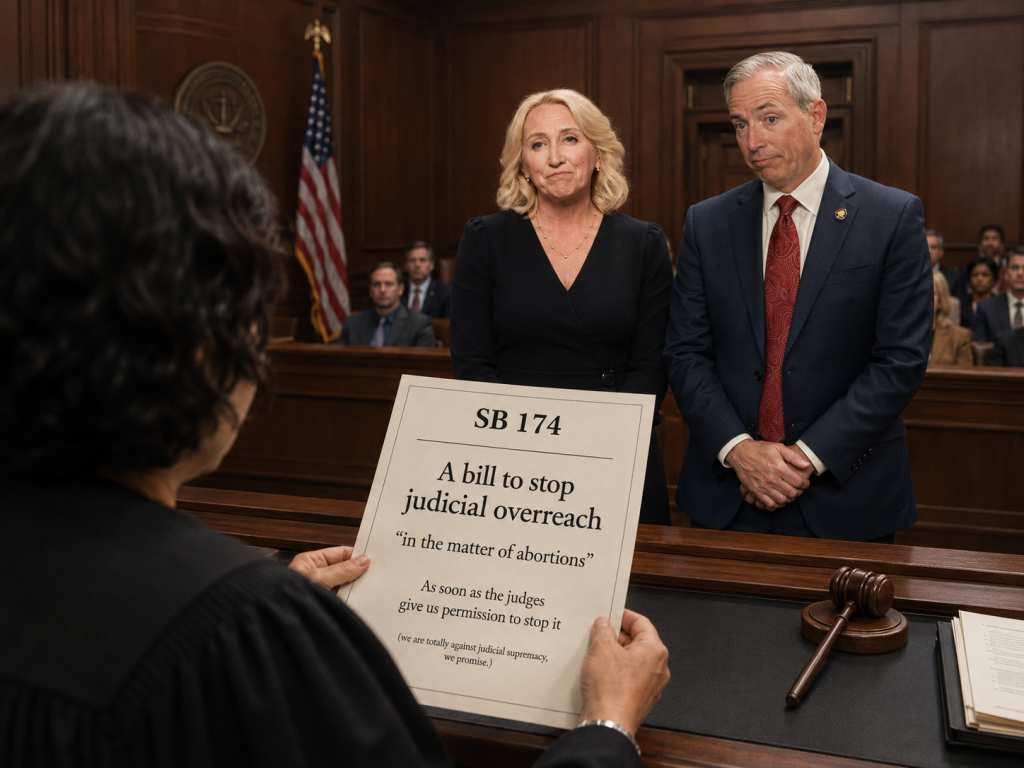
By making its operation subservient to a doctrine of judicial supremacy, the bill was neutered from the start.
3. Preliminary Injunction: A Judicial Remedy Turned Into A Weapon of Mass Destruction (Malfeasance #2)
On June 24, 2022, the Supreme Court issued Dobbs, and Utah legislative general counsel certified that S.B. 174’s contingency had been met. Planned Parenthood Association of Utah (PPAU) sued the next day. The Third District Court’s Judge Andrew Stone entered a temporary restraining order (TRO) and then a preliminary injunction (PI).
At the time that PPAU sued in 2022, Utah Rule of Civil Procedure 65A allowed preliminary relief if the applicant showed either a “substantial likelihood of success” or that the case presented “serious issues on the merits” that should be litigated further. That softer standard of “serious issues” was the route through which PPAU was granted an injunction—not through a finding that it was substantially likely to prevail. (see Utah Supreme Court, Planned Parenthood Association of Utah v. State, 2024 UT 28, Paragraphs 13-14, Page 6)
That injunction was the procedural mechanism PPAU invoked. The result was extraordinary: Merely because a supposedly “serious issue” was raised by a third party, a law enacted to protect unborn life remained suspended statewide, indefinitely—without a final judgment, without a jury verdict, without a hearing on the actual merits of the petition, and without direct representation for the unborn persons whose lives were at stake or for their families.
A preliminary injunction is supposed to preserve conditions temporarily while the merits of a case are decided. This remedy rests on the assumption that the preexisting status quo is less harmful than the condition it puts on pause. This assumption is meant to be tested promptly–but this never happened. The temporary order remained in place. For nearly four years, this preliminary instrument of judicial “relief” has functioned as the supreme law of the entire State.
Something almost never questioned is how the courts came to wield such power in the first place. Although injunctions do have a tradition as a remedy in equity courts going back to America’s founding, their scope was relatively quite limited; they are a whole different animal from today’s sweeping injunctions that can suspend laws (“legislating from the bench”). This usurpation took place as federal courts asserted powers, followed by state legislatures codifying those powers into their respective judiciaries. It cannot be overemphasized that the super-powers assumed by the courts would have been impossible without their delegation from the legislatures. This necessarily means that when legislators complain of judicial overreach, the very first place they ought to look for who is empowering those bad behaviors is themselves. Welcome to Passing the Buck 101.

Scope creep depopulates planets.
4. Nonfeasance #2: The State Chose Not to Build the Evidentiary Record
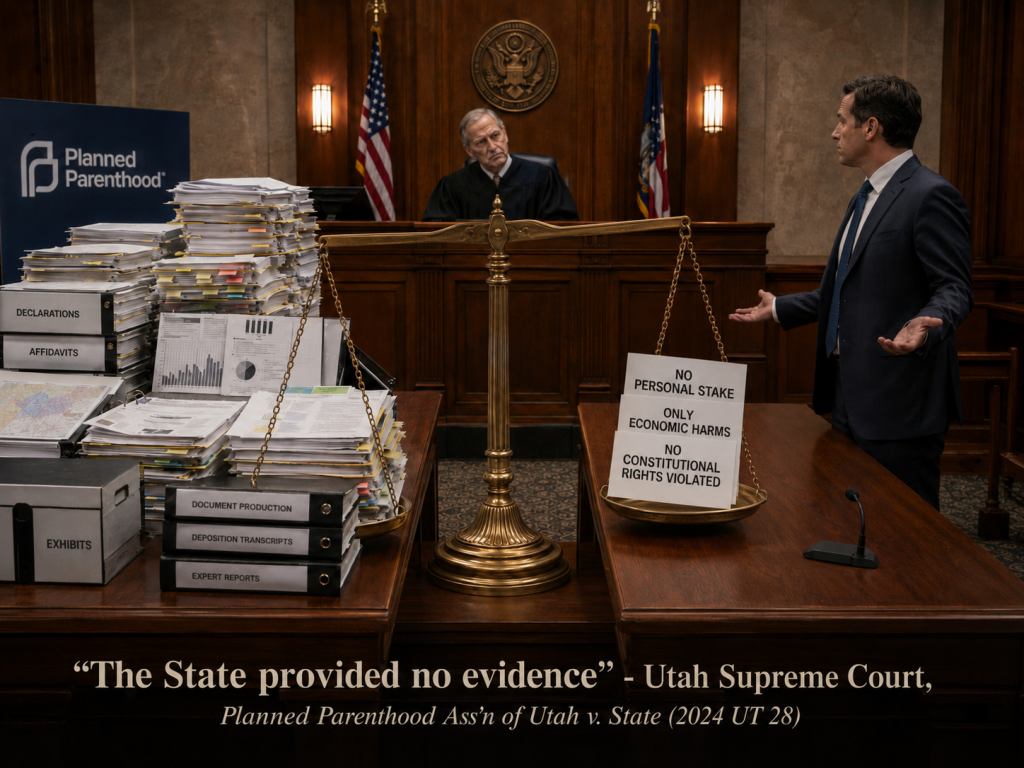
A damaging fact to the credibility of state actors who supposedly resisted the Planned Parenthood injunction is their documented failure to introduce evidence at important points. At the preliminary injunction stage, PPAU submitted declarations and other materials addressing alleged medical, economic, institutional, and patient harms. The State challenged PPAU’s standing and legal theories and submitted historical evidence concerning Utah’s abortion laws and Constitution, but it “opted not to introduce any evidence of its own” in response to PPAU’s filings alleging these types of harm. (Ibid., ¶¶ 18–35, especially ¶¶ 32–35 & n.4)
This omission materially weakened the State on appeal, where the district court’s balancing of harms was reviewed only for abuse of discretion on the record the parties had created. Although the State invoked its interest in protecting unborn life and called abortion’s resulting loss of life “obvious, indisputable, and irreparable,” the Court held that this omission created “difficulty: “The State provided the district court with no evidence to support its claims that SB 174 would further its interests or, conversely, that the injunction would result in any significant harm.” Id. ¶¶ 219–23. Whatever the merits of that reasoning and despite the abundance of available information documenting the harms of elective abortion, the State’s choice left PPAU’s factual presentation substantially unrebutted and deprived the State of the record it needed to challenge the district court’s balance-of-harms and public-interest findings.
Along the way, the State entered a precedent that injured a different right: “The State claimed that PPAU lacked standing because it has no “personal stake” in the dispute, that its only harm is economic in nature, and that it has no constitutional interest SB 174 implicates.” (¶ 32, p. 11) This angle of attack is worth noting because subsequent legislation closed the door to future prospective litigants on similar grounds.
These same legislators introduced H.B. 467 in 2023 as a second attempt to outlaw abortion by targeting abortion clinics. H.B. 467 faced a similar injunction–for brevity, we will leave a deeper analysis to a future article.
5. “Nonfeasance” #3: H.J.R. 2 Was Not Invoked Against the Injunction It Targeted
In 2023, Rep. Brady Brammer sponsored H.J.R. 2, with Sen. Dan McCay as Senate floor sponsor. The resolution amended Utah Rule of Civil Procedure 65A by eliminating the alternative standard under which an injunction could be issued because a case presented “serious issues on the merits which should be the subject of further litigation.” It also permits a party restrained by certain existing injunctions–including PPAU’s–to move for reconsideration under the new test; if the injunction fails the new standard, the court “must terminate” it. Brammer in his presentation to the Senate Judiciary Committee pitched H.J.R. 2 to the Senate as an instrument to fight the PPAU injunction on these grounds. If invoked, it would have required PPAU to demonstrate a “substantial likelihood” of success on the merits, erasing the weaker merits justification. H.J.R. 2 did not automatically terminate the injunction or require its automatic revalidation–It created a lever the State could pull.
Then the State refused to file such a motion.
After the Utah Supreme Court requested supplemental briefing on whether it should continue reviewing an injunction entered under the superseded standard, the State said that it “will not ask the district court to reconsider the existing injunction in the wake of any decision from this Court.” The Court recorded its reliance on that representation: “In light of the supplemental briefing, we did not rescind the grant of interlocutory review.” (¶ 41, 554 P.3d 998)
That decision left PPAU’s injunction operative, avoiding an immediate reassessment that could have terminated it and increasing the practical likelihood that it would remain operative while litigation continued. H.J.R. 2 thus exhibits a documented choice not to use a new remedy created with this very injunction expressly in view. Instead, the State pursued interlocutory review of standing and the district court’s exercise of discretion under the former rule—and lost both issues. The injunction remained in force without ever being subjected to H.J.R. 2’s replacement standard.
The State’s strategy did more than fail; it apparently backfired. Before the interlocutory appeal, PPAU possessed only a district-court standing ruling. By preserving Supreme Court review rather than invoking H.J.R. 2, the State sought a broader victory that might have ended the case for lack of standing. Instead, it obtained the opposite result: a binding Utah Supreme Court decision holding that PPAU possessed both traditional standing in its own right and third-party standing to assert its patients’ claimed rights. (¶¶ 45–81.)
An H.J.R. 2 motion could have tested whether the injunction survived the stricter substantial-likelihood standard without first converting the standing dispute into adverse statewide precedent. The State’s chosen strategy therefore preserved PPAU’s injunction under the superseded rule while materially strengthening PPAU’s legal position on standing.
To advertise legislation for a stated purpose and then fail to use it for that purpose is facial institutional nonfeasance. State officials represented H.J.R. 2 as a mechanism for requiring reconsideration of the PPAU injunction under a heightened standard, but the State declined to invoke that mechanism in the very case used to justify its enactment.
Classifying this inaction as “nonfeasance” does not require endorsing the constitutionality of S.B. 174 or assuming that reconsideration necessarily would have dissolved the injunction. It identifies an institutional omission: the Legislature enacted a new procedural tool and presented it as a means of testing, limiting, or terminating the PPAU injunction under a heightened standard, yet the State later declined to invoke that tool in the very controversy used to justify it.

H.J.R. 2 remained an unopened gift from the government to itself.
6. Who Is “the State”?
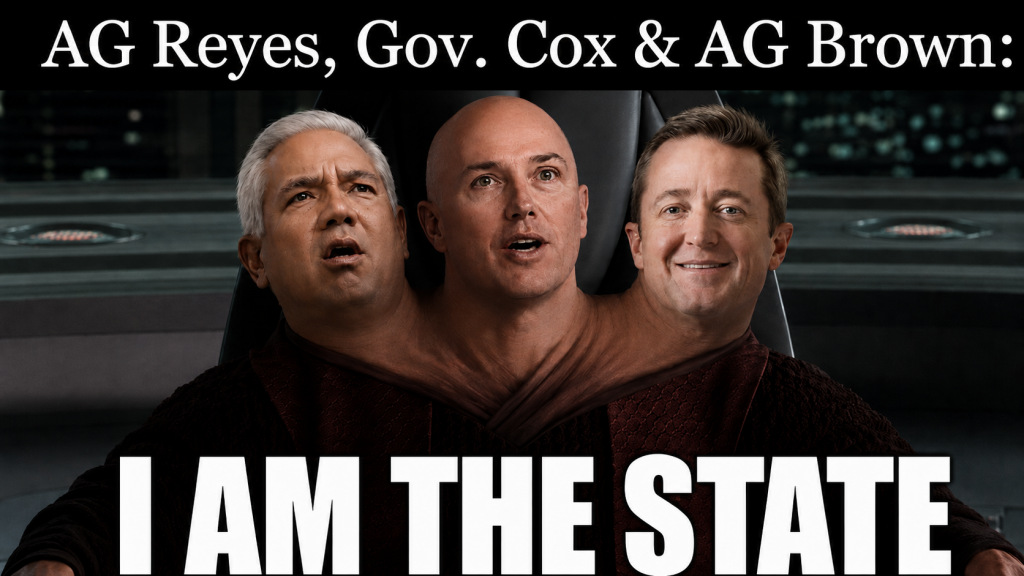
In the PPAU appeal, “the State” referred collectively to the appellants: the State of Utah, Governor Spencer J. Cox, Attorney General Sean D. Reyes, and the Director of the Division of Professional Licensing, represented by the attorney general’s appellate team. The Utah Legislature was not an appellant or other party in the case. The published opinion identifies it only as an amicus curiae represented by its own legislative counsel. (Ibid., caption and counsel listing.)
That separation diffused both authority and accountability among. The Legislature could point to its enactment of S.B. 174 and later amendment of Rule 65A. The governor could point to signing legislation. The attorney general could point to appealing the injunction. The judiciary could say it decided only the questions and record placed before it. But these separate acts did not produce a realistic, cohesive strategy for the defeat of PPAU’s injunction using every available mechanism: the executive appellants expressly declined H.J.R. 2 reconsideration, while the Legislature participated only as an amicus rather than intervening as a party and assuming a direct role in developing the record or controlling litigation decisions.
That is the governmental call-center loop: “We passed it.” “We signed it.” “We appealed it.” “We amended the rule.” “We are still litigating.” It is pretty effective window-dressing to make themselves look good when election season comes back around. Each one can pretend he is doing something that is “helping” to defeat abortion. Meanwhile, S.B. 174 remains enjoined, and elective abortion remains legal in Utah up to 18 weeks.
The Legislature’s Separate Litigation Power Is Worth Mentioning
The Legislature was not powerless to participate more directly. On a timely motion, Utah law gives it an unconditional presumed right to intervene as a party in any state-court action challenging the constitutionality of a state statute, the validity of legislation, or an action of the Legislature. The Legislative Management Committee could direct legislative general counsel to exercise that authority. The statute expressly requires legislative counsel and the attorney general to function independently in representing their respective clients. Utah Code § 36-12-7(4); Utah R. Civ. P. 24(a). This power exists; it was unused in the PPAU injunction challenge.
The Legislature therefore had a statutory route to become a separate party rather than remain merely filing as an amicus (“friend”) from the sidelines. Intervention would not automatically have made it an “injured party,” guaranteed success, or given it unrestricted control over the claims–but it would have allowed the Legislature to provide evidence and argument in its own name and protect its institutional interests independently of the executive’s litigation strategy. The legislature’s amicus posture offered the appearance of resistance without assuming responsibility for the legal strategy or the outcome of the litigation.

7. S.B. 203: A Weapon Enacted After the State Had Already Strengthened PPAU’s Position (“Nonfeasance” #4)
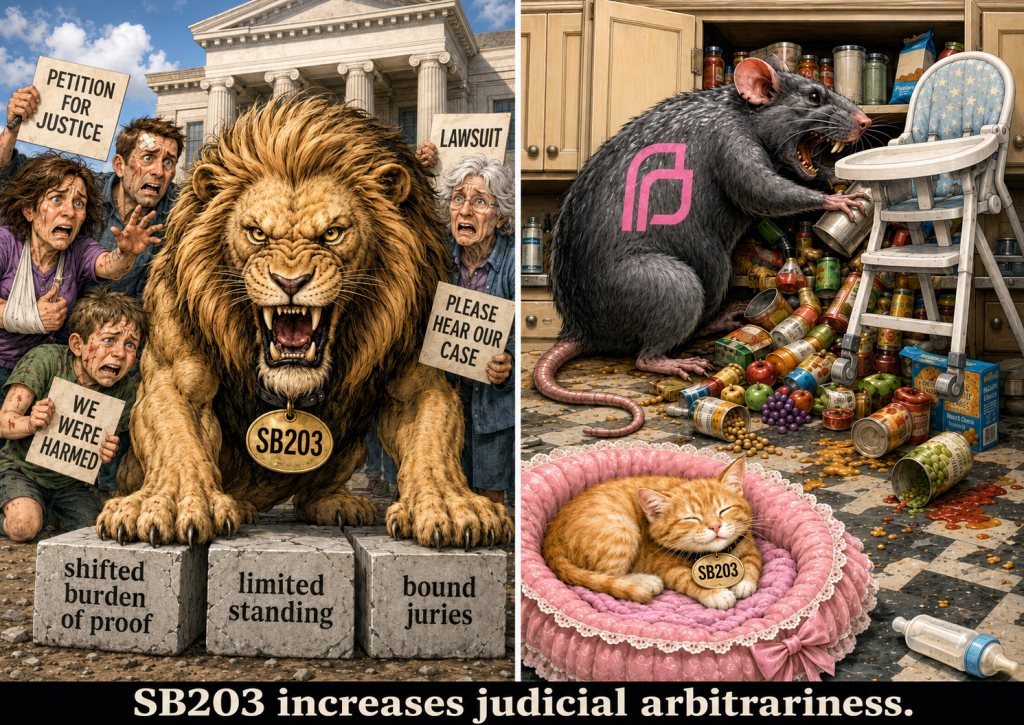
S.B. 203 (2025) appears to be directed at the precise third-party standing rule established in the PPAU appeal. The Utah Supreme Court held that PPAU had standing both in its own right and to assert its patients’ alleged rights, rejecting the State’s argument that being represented by a third-party required literal impossibility of suit by an actual patient. S.B. 203 subsequently adopted the State’s position in law: a plaintiff asserting another person’s rights must establish that “there is no way” for that person to sue personally, and the court “shall dismiss” an action that fails the statutory requirements. This made SB203 look like a roaring lion against Planned Parenthood. Contemporary reporting identified S.B. 203 as potentially affecting the PPAU litigation and as an apparent legislative response to the 2024 decision.(¶¶ 45–81; Utah Code § 78B-3-101.3(3), (6)).
But using S.B. 203 against PPAU is now an uphill battle in part because of the State’s earlier litigation choice. The failure to exercise H.J.R. 2 also meant that PPAU would not be subject to revalidation of its standing on such grounds. That earlier refusal could now be seen by the court as a waiver or estoppel against a later attempt to reopen the injunction through the route the State declined.
The Utah Supreme Court had also held that PPAU possesses both traditional and third-party standing. S.B. 203 did not take effect until May 7, 2025, contains no declaration that it applies retroactively, and therefore supplies no automatic authority for a district court to disregard the Supreme Court’s 2024 ruling. Utah Code § 68-3-3 expressly provides that Code provisions are not retroactive unless the Legislature says otherwise.
Even if a court allowed S.B. 203 to govern PPAU’s continued litigation prospectively, it would not necessarily remove PPAU from the case: The Supreme Court separately held that PPAU satisfies traditional standing because S.B. 174 directly subjects it and its personnel to criminal sanctions, licensing consequences, economic injury, and operational harm–this could be another weakness of that bill–it practically guaranteed that PPAU would have standing. If S.B. 203 was meant to stop PPAU, it was late to the party and missed the mark besides.
The sequence is therefore deeply self-defeating: The State surrendered the cleanest procedural opportunity to retest the injunction, preserved an appeal under the discarded rule, and obtained adverse statewide standing precedent. The Legislature then enacted S.B. 203 in language apparently designed to repudiate that precedent—but without application to PPAU. S.B. 203 may have been fashioned with this fight in view, but the government’s earlier choices made this particular case one of the hardest places to use it.
The lion became a kitten when it came to the Planned Parenthood suit. But it is still a crouching lion when its handlers want it to be.
8. “Nonfeasance” #5: S.B. 204 Created a Direct Appeal as of Right, but the State Did Not Trigger It
In 2025, Sen. Brady Brammer sponsored S.B. 204, “Right to Appeal Amendments”, with Rep. Casey Snider as House sponsor. It gives a party affected by certain injunctions against state law a direct appeal to the Utah Supreme Court when the claim alleges facial unconstitutionality. On appeal, the Court must decide both whether the trial court was correct and whether the plaintiff is substantially likely to prevail. This would fast-track Supreme Court review of the injunction’s merits basis, creating an opportunity to reduce the time the injunction remains in force.
But like H.J.R. 2, S.B. 204 is not self-executing. It does not dissolve an injunction, and a stay must still be sought separately to suspend its force. To use it against the S.B. 174 injunction, the State first needed a new district court order “granting, continuing, modifying, or refusing to modify” the injunction. H.J.R. 2’s Rule 65A reconsideration procedure again supplied the obvious route: ask the district court to revalidate the injunction under the substantial-likelihood standard, build the evidentiary record the Utah Supreme Court said was missing in 2022, and appeal if relief was denied.
That combination could have placed the injunction’s present validity squarely before the Utah Supreme Court. PPAU would have had to defend the injunction’s continuation under the current standard, on a renewed record. Surely the State would use this tool to rescue itself from its earlier refusal to act.
It did not. As of June 20, 2026, despite media claims citing the obvious applicability to S.B. 174, the State has so far not filed an S.B. 204 appeal directed at the S.B. 174 injunction.
S.B. 204 is a party-controlled litigation mechanism, not a general citizen remedy (especially since S.B. 203 drastically narrowed standing requirements, preventing citizens from joining the suit).
The introduced bill was stronger: it would have automatically suspended injunctions during appeal, required clear-and-convincing evidence, and resolved doubts in favor of constitutionality (“presumption of constitutionality”). Those provisions were removed before enactment following intense pushback. The surviving version is still potent.

Another extraordinary tool built for this special purpose, unused.
9. S.J.R. 9: Another Tip of the Hand—and Another Complete Miss
S.J.R. 9 (2025) further revealed the Legislature’s concern–perhaps paranoia–with injunctions against state laws. As introduced, it would have required a constitutional challenger seeking to stop a law before its effective date to seek TRO or preliminary-injunction relief within 28 days after the legislative session ended. As enacted, it was narrowed: for certain delayed-effect laws, a challenger who misses a 45-day pre-effective-date deadline is barred from obtaining a TRO until the law has operated for 90 days.
Had this rule existed in 2022, it likely would have prevented PPAU’s immediate TRO against S.B. 174, but not the preliminary injunction that became the real statewide restraint. S.J.R. 9 also did nothing to disturb PPAU’s already-existing injunction.
The practical burden inflicted by S.J.R. 9 clearly falls elsewhere. Institutional plaintiffs like PPAU monitor legislation, retain counsel, prepare declarations, and build litigation strategy long before a trigger date arrives. Blackout windows and tight deadlines such as S.J.R. 9 imposes leave such institutional actors relatively unaffected. On the other hand, ordinary citizens often do not know about the existence of a specific law that inflicts injury until enforcement begins; then they must identify the law, labor to understand the constitutional defects, find counsel or proceed alone, gather facts, draft pleadings, and satisfy injunction standards within an alarmingly short window under the new law. Missing the TRO deadline does not merely remove a label on the type of relief available: It removes the emergency procedure that forces rapid judicial attention. A preliminary injunction may remain theoretically available, but without a TRO, the citizen can be left under the challenged law until the court chooses to hear the motion–a matter of discretion for which there is no statutory deadline, and which also requires a heavier burden of briefing to allow. S.J.R. 9 on paper looks like a viable anti-abortion measure, but in reality it blocks access to remedies for injured parties and did nothing to help in the S.B. 174 fight. It is one of the clearest lockout mechanisms exposed to date, with no constitutional justification for its existence.

“The last remnants of the Old Republic have been swept away.”
10. H.B. 392/S.J.R. 5 Reveal the State’s Endgame: Exclusive Control Over Constitutional Venues
There is one set of newly enacted judiciary measures that the State is publicly documented as having invoked in the Planned Parenthood litigation, and it should trouble everyone.
Enacted in February 2026, H.B. 392 authorized the attorney general, governor, or Legislature to file a notice requiring a civil action involving a state entity or official to be transferred from its assigned district judge to a panel of three district-court judges. The notice could not be challenged by any party and was declared exempt from judicial review. Ordinary venue requirements do not apply to the transferred action.
S.J.R. 5 supplied the procedural machinery. It applied the transfer procedure to cases already pending on February 13, 2026. Once a qualifying State actor filed the notice, the assigned district judge was required to transfer the entire action to the panel and “may not sever any matter from the action or take any further action.”
The State then invoked that procedure in the existing PPAU case, seeking to remove the litigation from Judge Andrew Stone and transfer it to the new panel. On February 26, 2026, PPAU filed an emergency petition for extraordinary relief in the Utah Supreme Court, seeking to stop the transfer and challenging the panel mechanism, arguing that the mechanism is unconstitutional. It is.
The constitutional objection is not merely that the Legislature “regulated” the venue. It is that the mechanism gives selected State actors unilateral and purportedly unreviewable power to remove a pending case from its assigned judge who has jurisdiction. It also denies the opposing party the same latitude for venue selection. The Legislature criticized plaintiffs for “judge shopping”, while reserving to themselves unilateral power to do their own judge shopping. There is no constitutional authority to change venues or forbid any judges or juries from deciding a question of constitutionality.
The Supreme Court has agreed to consider the three-judge-panel challenge, together with related challenges arising from other litigation. Argument is expected in September 2026. As of the latest available case update, both the S.B. 174 and H.B. 467 injunctions remain in place.
The architecture was used broadly. Notices to convene three-judge panels were filed in the abortion-ban litigation, the Great Salt Lake public-trust case, and the redistricting case. In the Great Salt Lake controversy, the State invoked the mechanism after substantial proceedings had already occurred and while a dispositive motion was awaiting a scheduled hearing. In the redistricting litigation, the notice displaced the judge who had handled years of proceedings.
This repeated use supplies the larger proof. The mechanism was not merely about one allegedly activist judge, one abortion case, or one controversial doctrine. It concerned who controls the path of constitutional redress whenever state policy comes under attack.
H.B. 392 and S.J.R. 5 – don’t fight judicial overreach–they create it and concentrate it, in open violation of constitutional jurisdiction and Utah’s Open Courts guarantee–clear malfeasance.
This was the State’s first clearly documented use against PPAU of one of the new post-2024 litigation mechanisms discussed here. It did not ask Judge Stone to reexamine the existing injunction under the current Rule 65A standard. It did not first create a new injunction ruling for direct appeal under S.B. 204. It changed the tribunal that would decide the case. As with all new “tools in the toolbox”, we should ask:
Who can pull the lever?
Under H.B. 392 as originally enacted, the answer was the attorney general, the governor, or the Legislature—not the citizen, not the unborn child, and not the jury.
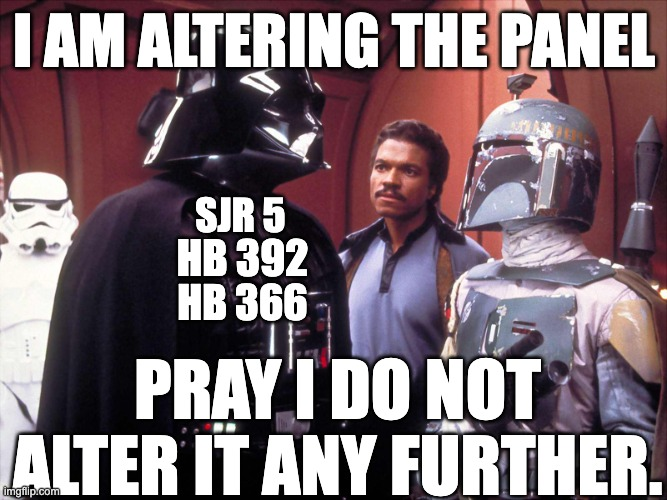
11. H.B. 366 – The Second Death Star (in case the first one gets blown away)
The constitutional objections to H.B. 392 and S.J.R. 5 were immediate and predictable. The Legislature’s answer was not to retreat from centralized adjudication of constitutional challenges–instead, it built insurance: H.B. 366 to preserve and reinforce it, just in case judges or plaintiffs found the previous laws unconstitutional.
H.B. 366 softens one of H.B. 392’s most conspicuous defects: It repealed and reenacted the panel statute so that either party—not only a State actor—may request a three-judge panel in a defined class of cases challenging state statutes, legislation, provisions of the Utah Constitution, legislative action or inaction, executive orders, administrative rules, or executive inaction, when declaratory or injunctive relief is sought against the State or a state official. The panel itself now decides whether the notice satisfies the statutory requirements.
That amendment reduces the original facial asymmetry of invoking the special venue, but it does not restore the proper constitutional forum. Qualifying litigation is still diverted into a specialized three-judge structure. Ordinary venue requirements still do not apply. The panel sits together for trials, injunctions, constitutional discovery disputes, and dispositive motions. H.B. 366 also preserved notices already filed under the earlier State-only version, including the notices that triggered the pending constitutional controversy.
H.B. 366 provides that if a court invalidates or enjoins the three-judge-panel statute, a separate “Constitutional Court” becomes effective. That court would be a statewide trial court consisting of three judges, with exclusive jurisdiction over a broad class of constitutional actions seeking declaratory or injunctive relief against state entities or officials. New qualifying cases would go there automatically. Pending qualifying cases could be removed there by notice within forty-five days after the fallback court became operative. Ordinary county and district venue requirements would not apply, and a case could not be transferred back to another Utah trial court unless the Constitutional Court lacked jurisdiction.
The design is unmistakable:
- If the three-judge panel survives, constitutional litigation is centralized in that panel.
- If the panel is invalidated or enjoined, constitutional litigation is centralized in the fallback Constitutional Court.
- In either event, the ordinary district-court path is displaced.
- In either event, constitutional challenges are separated from the local venue and ordinary judge to which they would otherwise be assigned.
- In either event, the Legislature has attempted to decide in advance which judicial structure will decide disputes over the Legislature’s own power.
H.B. 366 is therefore more than a technical repair bill. It is a litigation contingency plan written against judicial invalidation of the Legislature’s first plan.
The irony is difficult to miss. Officials claim to oppose judges who “legislate from the bench,” yet the Legislature responds by adjudicating by legislation: changing judicial structures, routing pending controversies, prescribing specialized tribunals, and constructing a replacement court in case judges invalidate the first one.
This is not separation of powers. It is consolidation of power.
The fallback court is not a harmless addition to Utah’s judicial system. Its jurisdiction is defined around constitutional challenges to state power. It therefore places the State’s most consequential disputes—claims that the Legislature or executive has violated the Constitution—into a narrow, more easily controlled court specifically constructed by the political branches being challenged.
A constitutional challenge is supposed to test the government’s conduct against law. Under this architecture, the government responds by changing the place, structure, and path by which that test occurs.
The ability of either party to invoke the government’s own special panel is hardly a concession–that panel is obviously constructed so as to decide cases in the manner most favorable to the government’s perceived interests. So it’s not just “Can you pull the lever”, but “Why would you want to?”
If one door is declared unconstitutional, H.B. 366 opens another door leading to the same room.
That does nothing to combat judicial overreach. It systematizes it.
We are seeing abundant evidence of a government most paranoid–and even all of this is just the tip of the iceberg.

12. H.B. 79, H.B. 330, H.B. 503, and S.J.R. 6 Create Liability Deflector Shields. Guess Who Gets to Use Them?
Why are we talking about governmental immunity in an article about how abortion is still legal? You will see why in a moment.
While Utah’s abortion ban remained blocked, the Legislature built heavily layered protections around the governmental, medical, and corporate actors carrying out abortions. Consider what each of the following accomplishes:
H.B. 79 creates immunity for governmental and medical actors. It covers governmental institutions, hospitals, employees, regulators, licensing decisions, inspections, public-health measures, discretionary acts and failures to act. It expressly operates retrospectively to March 18, 1985. Its public-health language includes action or inaction concerning “other conditions significantly affecting the public health,” broad enough to encompass governmental policy, regulation, licensing, enforcement, and nonenforcement–including abortion. Sponsors: Anthony Loubet, Brady Brammer
H.B. 330 creates general-purpose immunity for government actors and allies. It gives any “person” an affirmative defense when the alleged harmful conduct, omission, or condition was “authorized” by statute, rule, license, permit, governmental order, or another instrument carrying the force of law. That wording directly encompasses physicians, clinics, pharmacists, employees, contractors, and other participants acting within Utah’s presently operative abortion laws and licensing system. It also includes a retroactivity clause, protecting any and all conduct that was “legal” at the time. H.B. 330 preserves claims based on negligent performance, but it shields the underlying authorized act. A provider may still be sued for botching an abortion; the provider has a statutory defense against a claim that performing or assisting in the government-authorized abortion was itself wrongful. This is completely new as of the 2026 session. Sponsors: Colin Jack, Ronald Winterton
H.B. 503, S.J.R. 6 and numerous other bills add layers specifically shielding medical malpractice. H.B. 503 generally protects an adequately insured health-care provider’s personal income and assets from collection, preserves damages restrictions, and withholds specified medical-cost evidence until after liability and noneconomic damages have been decided. S.J.R. 6 places the same evidentiary separation into the Rules of Civil Procedure.
The jury therefore decides responsibility and noneconomic injury separately, without seeing specified evidence reflecting the full economic magnitude of the injury. The practical effect of this is that it becomes significantly more challenging to decide either question since both are interrelated. The provider’s personal assets remain protected, and the available insurance becomes the practical recovery boundary, effectively offloading the healthcare provider’s liability completely onto the insurance provider.
Abortion providers are to this day regarded as health-care providers. Consequently, they are immediate beneficiaries of these protections.
H.B. 467: Abortion Clinics Become “Hospitals”
H.B. 467 was sponsored by Karianne Lisonbee and Daniel McCay, the sponsors of the original abortion-ban legislation in opposite chambers. It was publicly presented as an alternative route to implementing the abortion ban by “eliminating abortion clinics”. Its text prohibited abortion-clinic licenses while creating a route for a qualifying clinic to be licensed under an expanded statutory definition of “hospital.” The statute then declared that such a facility was no longer an “abortion clinic.” The clinic thus disappeared by definition, not necessarily in operation. Although the mandatory reclassification was later repealed through H.B. 560 in 2024, reclassification as a hospital was still available under the amended language.
That reclassification is a major victory for abortion providers. It replaced the politically exposed category of “abortion clinic” with the trusted institutional label “hospital,” embedding abortion more deeply inside licensed, regulated, government-approved medicine. At a minimum, this is a major PR win for abortion providers. But it goes much deeper.

Abortion is given the State’s blessing
There is no bill description declaring that “abortion providers are immune to liability”–but this is nonetheless the operating law today, that was installed in the wake of the abortion ban injunction. The legislature left us enough breadcrumbs through nonfeasance and malfeasance in protecting and abetting the Planned Parenthood injunction and lawsuit through legislative lawfare to lead us right to this point. One of the most prevalent themes during the 2025 and 2026 legislative sessions was a headlong rush to provide abundant, excessive and redundant immunity for medical malpractitioners. Now we know why. The statutes protect every layer through general categories broad enough to include them.
The State defines lawful abortion, licenses the facility, licenses the practitioner, regulates the procedure, and then makes that authorization a defense against later civil liability.
Abortion isn’t banned in Utah. It is being subjected to regulatory monopoly and corporate capture.
While the abortion injunction battle stage drags on at a snail’s pace, the State is not eliminating abortion. It is monopolizing legal permission, classification, and providing immunities for state-approved abortion providers, at a speed more like a cheetah’s.
The State now determines who may perform an abortion, where it may occur, which professional and facility licenses are required, which clinic may be treated as a hospital, what conduct falls within the authorization, and dispenses liability immunity cards for those who comply with their regulations. This creates a protected State franchise.
Large hospital systems and corporate providers are best positioned to maintain compliance departments, employ credentialed personnel, purchase insurance, obtain institutional classifications, cultivate regulators, absorb litigation costs, and influence the rules controlling market entry. Independent actors are pressured to affiliate, consolidate, or disappear. So the economic as well as the regulatory framework, true to the tune of HB 467, isn’t banishing abortion providers and it certainly isn’t punishing them–it is welcoming them under the safe shelter of state-run hospitals, and granting them immunity. Operation Forceps, anyone?
13. Conclusion: Nothing Stopped Judicial Supremacy; State Actions Strengthened It
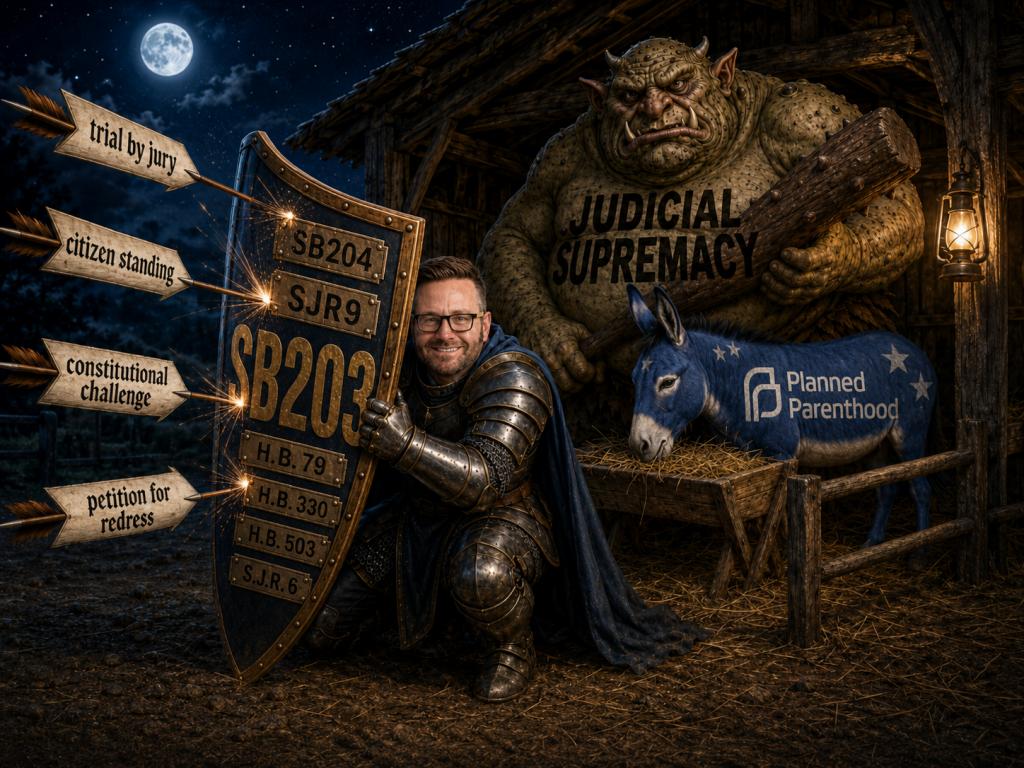
We have seen a track record of repeated nonfeasance, extraordinary measures, and then unexplained failures to use those extraordinary measures when they could have taken down the Planned Parenthood injunction or its suit altogether. When the State finally reached for a newly created procedural weapon, it did not remedy its past failures. Instead, it reached for control of the tribunal.
The donkey is now inside the corral, and those tools are now operative in protecting that donkey’s status, upholding the injunction against the abortion ban law, and even installing permanent and retroactive immunity for abortion providers.
The Charitable Explanation: Perhaps This Is “4-D Chess”
The most charitable explanation is that Utah officials have been playing a long and sophisticated game.
Perhaps they declined to invoke H.J.R. 2 because they believed their interlocutory standing appeal would end Planned Parenthood’s case more completely, more thoroughly or more finally. Perhaps they allowed the old injunction to survive because they thought they were preserving a better argument. Perhaps they delayed using S.B. 204 because they were waiting for the right appealable order. Perhaps they built the three-judge panel and fallback Constitutional Court as part of a grand strategy to defeat judicial supremacy and ultimately restore S.B. 174.
Whatever the excuse, the “4-D chess” defense offers bottomless plausible deniability: what appears to be retreat, error, inconsistency, unconstitutionality or failure is actually a brilliant maneuver whose purpose will become apparent only at the end. Well, we have chased it to the end and found citizens locked out from redress, and abortion providers guarded inside the State’s newly fortified castle. Meanwhile pro-life Utahans are asked to sit tight and “trust the plan”, and keep voting for the officials who are keeping abortion legal.
The held-out seeming possibility of “victory, eventually” cannot be disproven merely by observing that the promised victory has not yet occurred. Or maybe there really are allies of the abortion lobby on the inside. Maybe some of them really are incompetent, too. The record provides little rebuttal to this theory at some points. The wisdom of generations unseats naïveté: “If they were merely stupid, they would occasionally make a mistake in our favor”. Claims of hidden strategic wisdom must answer to the public record:
- The State did not answer Planned Parenthood’s factual showing with its own evidence.
- Its appeal produced binding precedent strengthening PPAU’s standing.
- It represented that it would not seek reconsideration under H.J.R. 2’s stricter standard.
- It did not create and appeal a new injunction ruling under S.B. 204.
- The injunction remained operative.
- Its first conspicuous use of the new machinery was to replace the assigned judge with a specially created tribunal.
That is a remarkable amount of losing for a strategy advertised as winning.
What Are We “Winning”?
The State may yet revive S.B. 174 and proclaim victory. But even that would not answer what has happened in the meantime.
The abortion prohibition remained suspended. Planned Parenthood’s legal position was strengthened. Standing and emergency relief were narrowed for future citizens. Constitutional cases were redirected into specialized forums. Governmental and government-authorized actors received expanding present and retrospective liability protections. The decisive procedural levers remained in government hands.
A future abortion victory could therefore leave the deeper defeat intact: the people receive the desired result in one case while losing control of the means by which every future constitutional controversy will be heard.
The question is no longer merely whether S.B. 174 eventually survives.
It is: What are we winning—and what have we already surrendered to obtain it?
I can answer that.
We are “winning” a police state.
That’s our prize for trusting untrustworthy politicians to “solve” abortion by creating unconstitutional tools. Let’s take account of what has actually been accomplished.
In response to unfavorable judicial rulings, the legislature constantly changes judicial procedure–including retroactively, controlling outcomes in an ongoing case.
It altered the injunction standard after the case began. It restricted standing after PPAU had entered. It created new appellate procedures, State-triggered panel transfer, and a fallback Constitutional Court. It retrospectively rewrote immunity law after the government lost its interpretation in court. It changed the legal consequences of past conduct and attempted to project its current interpretation backward into pending and accrued claims.
This is not ordinary prospective lawmaking. It is adjudication by legislation. The effect of it is to make the legislature practically unchallengeable. “Presumption of constitutionality” of laws directly conflicts with the presumption of innocence. They are installing a system that lets harmful conditions and laws stay in effect while they are challenged, and enables enforcement of bad laws causing irreparable harms, with no recourse.
The Legislature is choosing the standard, the available parties, the appellate route, the tribunal, the immunity, and—in practical effect—the range of outcomes, even after controversies have already arisen. Instead of allowing general laws to govern cases through ordinary courts, it repeatedly rewrites the machinery around particular classes of disputes while they are pending.
That does not defeat judicial supremacy. It merges legislative will with judicial power.
And not a whit of it is constitutional.
14. The Constitutional Solution: Replace Judicial Supremacy with Constitutional Nullification
The remedy to this conundrum, including how to defeat abortion, is not another State-controlled court, procedural weapon, or immunity statute. It is to restore the constitutional sequence: legislatures enact general laws, executives enforce them, courts decide actual cases, and juries protect the accused from unconstitutional punishment. Did you catch that last part? There are three branches to the tree of liberty, and they belong to the formal government. But there is also a trunk of this tree. The jury consists entirely of ordinary citizens, and it alone has power to nullify the unlawful acts of the other three. To see how the Constitution of the United States solves this problem, let’s first examine the defects, then understand the remedies:
I. The Constitutional Defects
| Measure | Constitutional defect |
| Injunction Power | Unconstitutional when used to suspend the operation of laws. This power equals legislating from the bench and rule by force. It is a foundation of judicial supremacy. This power is not delegated to the judiciary in Article III. See also Federalist No. 78. |
| H.J.R. 2 | Changed the injunction standard for pending cases and invited legislators to influence a particular judicial outcome. Rules controlling substantive remedies should not become retroactive legislative adjudication–this violates the ex post facto prohibition in Article I Sections 9 and 10. |
| S.B. 203 | Restricts standing and public-right redress, preventing citizens from challenging violations of duties owed to everyone. Government cannot make constitutional accountability depend entirely upon government-defined personal injury. Contradicts Article III and the Utah Constitution’s Article I Section 11 and is not pursuant to an enumerated power. |
| S.J.R. 9 | Delays emergency judicial relief during the period when a new law may inflict its greatest injury. It burdens ordinary citizens while institutional litigants can prepare before enactment. Flagrantly unconstitutional; this power does not exist. |
| S.B. 204 | Gives the State a special appellate weapon in constitutional-injunction cases. A State-only procedural advantage compromises equal process, biases courts and encourages legislative control over judicial outcomes. This power does not exist. |
| H.B. 392 | Permits forum manipulation through transfer to a specially constituted panel, potentially after adverse rulings. Government should not choose its tribunal or redesign the court around a pending controversy. All judges and juries are authorized to hear and decide matters of constitutionality. |
| H.B. 79 | Uses broad or retroactive governmental immunity to prevent injured persons from obtaining a hearing. Constitutional wrongs should be decided by juries, not extinguished before trial. Article 3 Section 2 Clause 3, 6th and 7th Amendments, Utah Article 1 Section 12. |
| H.B. 330 | Treats governmental authorization as a defense for unlawful official conduct—the functional equivalent of “I was following orders.” Public office cannot convert unconstitutional conduct into lawful conduct. Flagrantly unconstitutional; broad governmental immunity from liability is nowhere authorized in the state or national constitutions. |
These measures share one defect: they regulate who may complain, when relief may issue, which tribunal will hear the complaint, and whether government may be held liable—without restoring the people’s authority to decide the ultimate constitutional controversy. The branches pretend to be fighting one another and offering a check on each other when in fact they are sharing power with each other, and locking the people out from redress, deleting our right to self-government.
II. Trial By Jury Is The Real Trump Card
Under constitutional due process, bad laws may be nullified in individual cases and good laws upheld against challenge:
- An elective-abortion ban and a mask mandate are enacted and published.
- An executive officer or member of the citizen militia arrests a person upon probable cause that the person violated one of the laws. The enforcer acts on personal responsibility for the arrest and any harms caused by personal actions.
- If the enforcer is civilly sued or criminally accused, the enforcer receives a speedy public trial by jury. An indictment or presentment is first required for a capital or infamous criminal charge.
- The jury renders a verdict that considers the lawfulness of the enforcement.
- For the abortion ban, if the judge or jury finds the law constitutional and the enforcement lawful, the jury acquits the enforcer or finds no civil liability for the lawful and humane enforcement of it.
- For the mask mandate, if the judge or jury finds the law unconstitutional and the enforcement injurious, it may award damages. In a criminal case, it may convict only if the enforcer violated a preexisting criminal law—including any expressly defined offense for knowingly violating the oath of office—and every element is proven beyond a reasonable doubt.
- The person originally arrested also receives a speedy public jury trial.
- The jury renders a verdict on the alleged violation. It may also weigh the validity of the law.
- Under the abortion ban: if the judge or jury finds the law constitutional and every element proven beyond a reasonable doubt, the jury may convict the accused.
- Under the mask mandate: if the judge or jury finds the law unconstitutional, it may acquit regardless of whether the defendant factually performed the act prohibited by its text.
Each verdict binds only the parties to the case. The abortion ban is upheld in the case in which the jury sustains it; the mask mandate is nullified in the case in which the jury rejects it. Neither verdict becomes legislation governing absent persons.
In this way, judicial overreach, legislative overreach, and executive overreach are all adequately checked and abolished.
The jury is the proper instrument both for providing immunity for enforcers of good laws, as well as for providing nullification of bad laws, acquitting those who are accused of breaking them.
Utah’s own Constitution expressly states in Article I Section 2 that all political power is inherent in the people. This includes prosecutorial power, standing, and the power of defense in criminal and civil cases. The people alone may grant immunity; the people alone may breach immunity through a bona fide verdict by an impartial jury of peers.
Now, want to see a neat trick for getting every citizen engaged in expelling bad laws?
We are going to convert bad laws into tax dollars. This makes the punitive and judicial side of the law into something visible, measurable and opposable.
Repeated trials under a frivolous, unjust, or unconstitutional law convert that law into a tax burden that must be accounted for. The full cost of enforcement, investigation, prosecution, defense, jurors, courts, detention, and appeal should be published and attributed to the law being enforced. Repeated acquittals would then force legislators either to repeal or amend the law, abandon its enforcement, or openly tax the people to continue funding prosecutions that juries refuse to sustain.
Plea bargains are forbidden by the Constitution and ought to be prohibited in law as well. They conceal the weakness of bad laws, replace public jury judgment with prosecutorial pressure, and manufacture convictions that conceal the true cost and failure rate of enforcement. Every accusation should therefore proceed to dismissal or public trial, so the law’s constitutional validity, evidentiary strength, and total public expense remain visible. Imagine seeing a public cost of enforcement and acquittal rate next to each legislator’s bills!
Justice and mercy will always carry a cost. The purpose is not to make lawful prosecution impossible, but to ensure that frivolous laws and abusive prosecutions cannot be enforced on the people’s taxes, silently, and without political consequence.
The Citizen Redress Lockout, Evidenced Step-by-Step
| Step | What happened | Who got power | Who was locked out |
| 1. S.B. 174 creates provider exposure | Utah’s trigger ban threatened providers with felony penalties, licensing consequences, and clinic action. | PPAU got concrete injury and standing. | Unborn children received no representation; citizens had no equivalent enforcement standing. |
| 2. Old Rule 65A opened the injunction gate | PPAU only needed “serious issues on the merits,” plus harm/balance/public interest. | Judge Stone could suspend enforcement before merits trial. | Citizens could not force a merits verdict or jury review. |
| 3. State failed to build record | The Utah Supreme Court says the State opted not to introduce its own evidence responding to PPAU’s harms and did not introduce evidence supporting S.B. 174’s ability to advance its goals. | PPAU’s evidentiary framing controlled the PI record. | Citizens could not supplement the State’s failure as of right. |
| 4. H.J.R. 2 narrowed the gate behind PPAU | H.J.R. 2 removed “serious issues,” but only allowed an enjoined party to move for reconsideration. | The State got an optional tool. | Citizens got no direct trigger. |
| 5. State refused reconsideration | The State told the Utah Supreme Court it would not ask the district court to reconsider the existing injunction. | Executive-side defendants preserved the injunction posture. | Citizens could not force the State to use H.J.R. 2. |
| 6. S.B. 203 narrowed citizen standing | Brammer codified injury-in-fact, causation, redressability, strict third-party standing, associational pleading, and dismissal. | Judges got a statutory lockout rule. | Public-right citizen suits became harder. |
| 7. S.B. 204 created State-centered appeal power | Defendants/affected parties can appeal injunction orders against state law directly to the Utah Supreme Court. | The State got an appellate weapon. | Citizens outside the case still lack a clean path. |
| 8. S.J.R. 9 added timing traps | TRO challenges to delayed-effective-date laws face timing rules. | The State benefits against future challengers. | Future citizens/plaintiffs face stricter emergency access. |
| 9. H.B. 392 created State-triggered forum control | AG, governor, or Legislature may file a notice convening a three-judge panel; the notice may not be challenged and is not subject to judicial review; venue rules do not apply. | State institutional actors control forum transfer. | Citizens cannot equivalently force the State to defend, enforce, or restore jury process. |
| 10. S.J.R. 5 operationalized the panel transfer | If AG/governor/Legislature files a panel notice, the assigned judge must transfer and may take no further action. | State actors can freeze the assigned judge and move the case. | The original plaintiff’s venue choice and assigned judge are displaced. |
| 11. H.B. 366 builds fallback court architecture | If panel provisions are invalidated/enjoined, a Constitutional Court structure is created; venue rules do not apply there either. | The State preserves a backup centralized forum. | Citizens remain dependent on State-triggered architecture. |
| 12. H.B. 79 expands immunity | Governmental immunity is broadened, including discretionary functions whether discretion is abused. | Officials are insulated from citizen damages/accountability. | Juries are displaced from constitutional injury claims. |
Leave a Reply